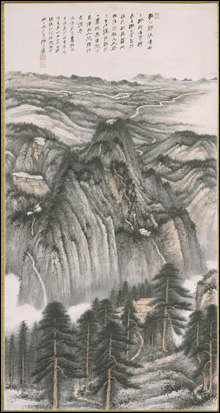
MOUNT EMEI OF SICHUAN: Zhang excelled
at Chinese painting’s traditional expressive
improvisational-feeling brushwork. |
While surveying the Museum of Fine Arts’ collection of Chinese paintings over the past few years, staff members came upon an ink painting of a majestic knotty mountain with people lounging and fishing at pavilions in a misty river valley at its foot. It was a sublime scene, even though the seven-foot-tall painting was cracked, threadbare in places, patched in others, and dulled by a gray-brown murk. Attributed to the 10th-century artist Guan Tong, the painting was acquired by the MFA in 1957, and it was hailed as a landmark addition to the museum’s collection. But over the years it quietly slipped into obscurity.
That obscurity was one sign that something wasn’t quite right. Neither MFA Chinese art curator Hao Sheng nor research fellow Joe Scheier-Dolberg, both of whom began working at the museum about three years ago, were familiar with the piece, Drinking and singing at the foot of a precipitous mountain, when they pulled it out of storage. “A painting of this caliber,” Scheier-Dolberg tells me, “so early and so important, we certainly would have known about it.”
Seals indicated that the painting came from the collection of the 12th-century emperor Huizong. A colophon (a collector’s praise) written at the top purported to be by Zhao Mengfu (1254–1322), said to be the most accomplished calligrapher of his day. These eminent affiliations threatened to be too good to be true. The style seemed off. And most suspicious of all, the painting had come from the collection of Zhang Daqian.
“Zhang Daqian: Painter, Collector, Forger” | Museum Of Fine Arts, 465 Huntington Ave, Boston |Through September 14
“A Tradition Redefined: Modern and Contemporary Chinese Ink Paintings from the Chu-Tsing Li Collection, 1950–2000” | Sackler Museum | Harvard University, 485 Broadway, Cambridge | Through January 27 |
Zhang (1899–1983) was a celebrated Chinese painter, preeminent collector — and an infamous forger, whose bogus works have duped the British Museum, the Smithsonian, and other illustrious institutions. Which explains the title of the MFA’s intriguing 20-work exhibit, “Zhang Daqian: Painter, Collector, Forger,” which includes the MFA’s suspicious painting, shown here attributed to Zhang for the first time.“He was an absolute character,” says Scheier-Dolberg, who organized the show. “Even as a young man, he started to affect the style and dress of a 10th-century scholar. He had a long flowing beard and long traditional scholarly robes.” He collected old Chinese works and traveled to see them, to train his connoisseur’s eye and his artist’s hand. From 1941 to ’43, he lived at Dunhuang, like a traditional student, copying remote desert cave murals from the 5th century.
Zhang was considered a talent in his own right. In 1950, the MFA thought it acquired its first Zhang artwork, a painting of mountain peaks. Three years later, Zhang, who had left China in 1948 as Communists took over (he would live in Japan, Brazil, California, and Taiwan), visited the MFA and declared the painting a forgery. “Insisting that a museum of the MFA’s stature must have an authentic Zhang,” a wall text explains, he gave the museum his striking ink painting Mount Emei of Sichuan (1953) to take its place.
