Luisa does Isabella in China, Gohlke does America
By GREG COOK | July 1, 2008
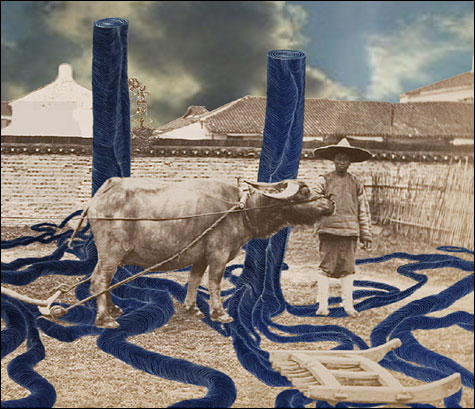
DREAMSCAPE: Rabbia creates a montage of images from Mrs. Gardner’s Chinese scrapbook
intercut with her own video and animation. |
“Luisa Rabbia: Travels with Isabella, Travel Scrapbooks 1883/2008” |
Isabella Stewart Gardner Museum, 280 The Fenway, Boston | Through September 26
“Accommodating Nature: The Photographs Of Frank Gohlke” |
Addison Gallery, Phillips Academy, 180 Main St, Andover | Through July 13 |
In the fall of 1883, Isabella Stewart Gardner — more than a decade before she would develop her museum on Boston’s Fenway — traveled to China. As she toured Shanghai and Beijing, Hong Kong, Canton, and Macao, she purchased photographs from local photographers of sights she’d seen as well as of people and things she hadn’t. She pasted all these sepia-toned pictures into a scrapbook, and that became a spark of inspiration when Luisa Rabbia was an artist-in-residence at the Gardner Museum last summer. The result is “Travels with Isabella, Travel Scrapbooks 1883/2008,” in which the Italian-raised, Brooklyn-based 37-year-old transforms Gardner’s old travel photos into a dream journey.Rabbia’s 27-minute video, which is now on view at the museum along with Gardner’s scrapbook, begins (and also ends) with an image from the cover of the scrapbook before proceeding in one long, leisurely pan past Gardner’s photos of temples, pagodas, and palaces. Rabbia cuts out sections and inserts her own video (gliding birds, billowing clouds, rolling waters, waving branches, fire) and bits of animation.
Water floods a lavishly appointed room (the home of a British regional governor). A whirlpool (perhaps the drain of a bath) spins in the center of a harbor. A pair of men hold guitar-like stringed instruments. Growing branches of a tree burn. Sculptures of dragons hold a globe in an astrological garden. The photos are organized not by chronology or geography but by the way one flows visually into the next, as in the disjointed order of memories.
Rabbia’s primary addition is blue lines that snake across the ground, wiggling around feet and landscapes and buildings, sometimes sprouting upward. She sees them as trees and roots. “The tree is a collection of time in itself, and roots are an expression of that,” she tells me at the museum. “And these roots have rings all around which are like the rings of time past. It’s a link from the past to the present.”
The blue lines also suggest water or veins or, when they sprout up, penises. At one point, blue lines zigzagging across a sepia landscape produce throbbing red rivers of what appears to be blood. Later a full moon rises with pulsing veins inside. (It’s actually a scan of a beating heart that Rabbia found on-line.)
Other strange visions appear: a metal ostrich lays a blue marbled egg; a naked woman lies in a courtyard and a tree sprouts from her crotch; two prisoners wait with square boards locked around their necks; a lynched individual swings from a tree; at the back of a procession people carry a breathing cocooned body atop a litter (actually a photo of a Peking wedding procession transformed here into a funeral). There is a vague suggestion of things falling apart.
 Related
:
Time out of mind, Lighting history, Art in the air conditioning, More 
- Time out of mind
Luisa Rabbia created a slow-moving video work that offers a kind of travelogue of her own journey through Isabella Stewart Gardner's historic scrapbooks.
- Lighting history
On January 1, 1903, Isabella Stewart Gardner invited 300 guests to a private concert by members of the Boston Symphony Orchestra to celebrate the opening of her new museum on the Fenway. After performances of Bach, Mozart, and Schumann, the mirrored doors of the first-floor concert room rolled open to reveal an extraordinary vision.
- Art in the air conditioning
From Picasso to William "Shrek" Steig's cartoons, and surfer photos to a Twilight Zone toy store, New England offers art worth traveling to this summer. Here we round up the best in the region, no matter the weather or your artistic inclinations.
- Photos: Topping Ceremony at the Isabella Stewart Gardner Museum
Getting topped
- How a Rembrandt wound up on a pig farm
The next time you're bored on a Friday night and considering a caper at the RISD Museum, Anthony Amore wants you to consider this: you're more likely to make a few bucks begging the high school crowd on Thayer Street.
- Musical acrobats
Having Antonio Sanchez explain the difference between "straight 8's" and "swing 8's" is a bit like having Einstein explain long division — total waste of the dude's time.
- Stolen
By buying up her favorite artworks and displaying them for posterity in her museum, Isabella Stewart Gardner removed them from the sphere of commerce and preserved them for the enjoyment of all.
- Pottery, Potter, mummies, and a 'Rare Bird'
The art of 2000 BC Egypt, visions from the Iraq War and AIDS activism, and the magic of a digital technology and Harry Potter make up the highlights of Boston's autumn art calendar.
- 52 ways to leave 2009
Your usual lackadaisical approach to New Year's Eve — just see what happens and go with the flow — is not going to cut it this year. Sure, the end of this decade may not have the same kind of new-millennium pressure riding on it as the last one, but the plunge into 2010 is a milestone nonetheless.
- Fresh fruit and vegetables
The bleakest months of New England winter are ahead of us, so the prospect of leaving your toasty house to see art may not be at the top of your to-do list.
- Works in progress
Back in October, Minnesota photographer Alec Soth spoke at MassArt. "Facebook: 15 billion uploaded photos," he said. "At its busiest, 550,000 images each second being uploaded. So I've been struggling with that. How do I function as a photographer in that environment?"
- Less

Topics:
Museum And Gallery
, Culture and Lifestyle, Ludwig van Beethoven, Hobbies and Pastimes, More
, Culture and Lifestyle, Ludwig van Beethoven, Hobbies and Pastimes, Photography, Weather, Isabella Stewart Gardner Museum, Isabella Stewart Gardner Museum, Frank Gohlke, Addison Gallery Phillips Academy, Arts and Crafts, Less
