Rachel Whiteread’s dollhouse village at the MFA, Erwin Redl’s red-light district at Emerson
By GREG COOK | October 27, 2008
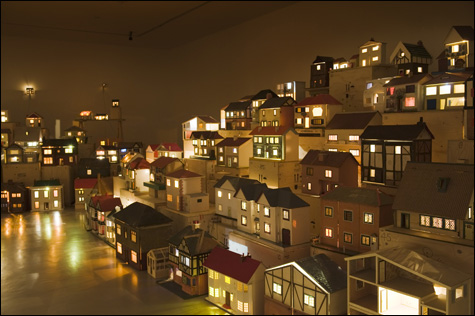
ABSENCE/PRESENCE: When she started on Place (Village), Whiteread was thinking of Pompeii and
Italian Nativity scenes. |
Photos: Rachel Whiteread exhibit at the MFA
Rachel Whiteread | Museum of Fine Arts, 465 Huntington Ave | Through January 25
Erwin Redl, “Fade: A Light Installation” | Huret and Spector Gallery, Emerson College, 10 Boylston Place | Through November 30 |
The gallery is dark for Rachel Whiteread’s Place (Village) installation at the Museum of Fine Arts, except for lights glowing within the neighborhoods of little houses stacked up around the edges of the room, as if on three hillsides. They turn out to be more than 200 second-hand dollhouses that the 45-year-old London sculptor has stacked on the wooden shipping crates they were sent to the museum in. It feels like bedtime in the village of girlhood dreams.The installation is a bit of a shift for Whiteread, who’s best known for making plaster, rubber, resin, or concrete casts of old used mattresses, sinks, the hollows underneath chairs, a two-story staircase, the entire interior of rooms. She won the big-deal British art award the Turner Prize in 1993 just after she created House, a concrete cast of the stripped-bare interior of a condemned Victorian house in London.
MFA contemporary curator Cheryl Brutvan (who is expected to leave the museum by the end of the year, with unspecified plans) has put together a sharp, small, focused show. She gives context to the installation with a sampler of six Whiteread sculptures and 16 drawings and collages. Untitled (Amber Floor) (1993) is a fleshy yellow rubber cast of worn floorboards. Wait (2005) features plaster casts of cardboard boxes — with all their dents and dings — stacked on and under a chair. Cabinet XI (2007) is a metal medicine chest filled with plaster casts of the insides of pillboxes. In-Out-VI (2004) is the result of casting a door and then turning it inside out so that it becomes a new door. Whiteread’s style comes out of classic Minimalism — simple, spare boxes, emphasis on materials and their placement in the gallery — but she warms it with the objects’ sense of past use by people now gone in places now lost. Her sculptures often feel like gravestones or mausoleums or ghosts.
“I started collecting dollhouses over 20 years ago,” she tells me. “I had no idea whatsoever where they were going. I just started picking them up in flea markets and stuff. It was completely connected to everything that I’ve always done. It had to do with the interiors of them, and opening the doors and seeing these strangely decorated landscapes that were people’s ideas of what the perfect house would be. And their kind of strangeness of oversize wallpaper — the scale of the wallpapers was directly related to the suburban house they lived in, and they just kind of put the scraps in the doll’s house, and bits of carpet and stuff. So they were little versions of mini-me, the people that had made these. And then they’d been passed down through generations and then eventually just spat out somewhere for me to collect.”
 Related
:
Photos: Exposures, Slideshow: Titian, Tintoretto, Veronese at MFA, States of the art, More 
- Photos: Exposures
A slideshow of photos from Yousuf Karsh, William Christenberry, and the PRC
- Slideshow: Titian, Tintoretto, Veronese at MFA
At the Museum of Fine Arts, Boston.
- States of the art
In New England, where you can't swing a sack of cranberries without hitting a venerable cultural institution, anyone with access to a car (or even a subway pass) can scope out these topnotch art museums.
- Photos: The Secrets of Tomb 10A at MFA
Photos of an Ancient Egyptian exhibit on display at the Museum of Fine Arts
- Modern times
Does Jen Mergel's appointment mean that the MFA is getting serious about contemporary art?
- Art in the air conditioning
From Picasso to William "Shrek" Steig's cartoons, and surfer photos to a Twilight Zone toy store, New England offers art worth traveling to this summer. Here we round up the best in the region, no matter the weather or your artistic inclinations.
- Slideshow: The MFA's Luis Melendez exhibit
Images of Luis Melendez's show at the MFA
- Bon appétit!
Luis Meléndez himself greets you at the outset of "Luis Meléndez: Master of the Spanish Still Life" at the Museum of Fine Arts. He seems a haughty 31-year-old in this 1746 self-portrait, standing in a fine silk coat and ruffled shirt and holding up a chalk drawing (note the chalk in his hand) of a hunky nude dude.
- Three's company
The show's American curator, Frederick Ilchman, has snagged an improbable number of pairs and trios from the world's famous (and not so famous) museums.
- Exposures
In "Karsh 100: A Biography in Images," which is now up at the Museum of Fine Arts, his iconic shots of Winston Churchill, George Bernard Shaw, and Ernest Hemingway are defining portraits of the men in all their crusty manliness.
- More than a feeling
The centerpiece of the Museum of Fine Arts' "Contemporary Outlook: Seeing Songs" is Candice Breitz's 2005 Queen (A Portrait of Madonna), a wall of 30 televisions, each showing a different Madonna fan singing a cappella to her 1990 greatest-hits compilation, The Immaculate Collection. They wear headphones, bob their heads, sing aloud to music we can't hear.
- Less

Topics:
Museum And Gallery
, Visual Arts, Cultural Institutions and Parks, Museums, More
, Visual Arts, Cultural Institutions and Parks, Museums, Museum of Fine Arts, Museum of Fine Arts, Museum of Fine Arts, Brandeis University, Emerson College, Emerson College, Emerson College, Less
