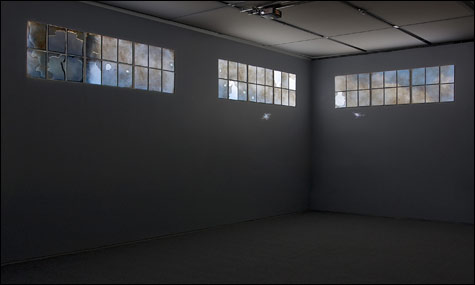
EMBEDDED: Rather than recounting a memory, Wodiczko involves us in a visual and audio experience that becomes our memory. |
| Krzysztof Wodiczko | . . . Out of Here: The Veterans Project | Institute of Contemporary Art, 100 Northern Ave, Boston | Through March 28 |
For the majority of us Americans, Iraq and Afghanistan are a series of news-data points — number of Americans killed today, number of car bombs, spending tallies, estimates of civilian deaths. We connect these dots to try to form a hazy picture of Iraq, where at least 4276 Americans have died and 30,182 have been wounded and as many as 93,793 Iraqi civilians have been killed since we began our fight there six and a half years ago.Stories with intimate details can help us to understand. Recent studies have shown that being in pain and watching someone else in pain activate similar areas of the brain. But most of our war reporting is data, not narratives. That’s what makes Krzysztof Wodiczko’s new video installation, . . . Out of Here: The Veterans Project, at the Institute of Contemporary Art, so powerful, and so necessary.
You stand in a large dark gallery lined with (projections of) grimy factory-style windows 13 feet above the floor that show blue sky and blurry clouds. “Outside” you hear kids playing, giggling. Adults call to them in what must be Arabic. A radio broadcasts Barack Obama telling us that “we need to use diplomacy to resolve our problems wherever possible” and a report that “a senior Hamas official has told Al Jazeera that this is a Martin Luther King moment.”
A man sings in Arabic as a helicopter — seen in silhouette in the windows — whumps down and hovers. The darkness and the height of the windows make you feel cut off, blind, but also safe. Kids kick a soccer ball past a window, then aloft again; it shatters one of the panes.
The helicopter flies away. Vehicles rumble to a stop. “We were here before. Remember that?” a man says in English. “What’s going on?” a voice asks over a radio. A leader barks orders. “Get the kids out of here,” a radio voice says. “Look at that pile of trash.” A thump. A child screams. Gunfire. “What’s going on up there?” Suddenly we’re part of an American military patrol. Or so it seems. Everything is out of our view in this dark room with the too-high windows. We’re secret witnesses.
Wodiczko was born in Poland in April 1943, right in the middle of World War II. When he was serving in the Polish army, he says, his unit was told it might have to leave the next day to man missiles in Siberia during the Cuban Missile Crisis of 1962. That wound up not happening. “I was lucky,” he tells me at the ICA. “We were all lucky.”
He began coming to the United States in the 1970s. He’s taught at the Massachusetts Institute of Technology on and off since 1992. He describes himself as a nomad, with bases in Cambridge, New York, and Warsaw. “I’m not stable.”
