Carole Lombard’s nine years of stardom
By STEVE VINEBERG | October 8, 2008
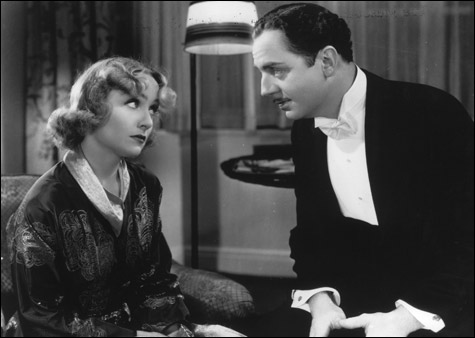
MY MAN GODFREY: This one’s ’30s-style eccentricity is hugely entertaining. |
| “Carole Lombard: No Dumb Blonde” | Brattle Theatre: October 18-23 |
Carole Lombard rose to stardom in 1934 and was dead by 1942, killed in a plane crash on her way back from selling war bonds; her last picture, Ernst Lubitsch’s To Be or Not To Be, was released posthumously. She was one of the great funny girls of the Depression era, as witness the five features in the Brattle’s upcoming series “Carole Lombard: No Dumb Blonde” (October 18-23). Her compact but pointed face, the soft blond crown of hair, the sleek, elegant frame that satin and silk and lamé either clung to or dripped off, all made her a ’30s icon — the billboard for her 1936 film Love Before Breakfast is at the center of one of Walker Evans’s photographs. In straight pictures she was competent and always lovely, but she was at her best in comedies, where she could add a goofy quality to her glamor.The films in the series include her three finest — TWENTIETH CENTURY (October 19-20), MY MAN GODFREY (October 18 + 23), and NOTHING SACRED (October 21-22) — as well as her two last, MR. & MRS. SMITH (October 21-22) and TO BE OR NOT TO BE (October 19-20). Twentieth Century, superbly directed by Howard Hawks from a breakneck script by Ben Hecht and Charles MacArthur, came out in 1934, the year the Production Code went into effect and filmmakers invented romantic comedy as a way of negotiating the creative restrictions it placed on them. It’s a mixture of romantic (screwball) and backstage comedy. Lombard plays Mildred Plotka, a lingerie-model-turned-actress who lands the lead in a Broadway play because producer Oscar Jaffe (the inimitable John Barrymore) — who promptly renames her Lily Garland — is convinced he can turn her into a sensational actress. He succeeds, and they become partners, on stage and off. But his megalomania and jealousy eventually drive her away — to Hollywood, where she becomes an even bigger star. The movie, most of which takes place three years later on board the Twentieth Century, the cross-country train that was all the rage in the period, is about a pair of battling egomaniacs who can’t distinguish between theater and life; even when Lily bemoans her own penchant for unending melodrama, she’s playing a scene.
This was the role that made Lombard a star. It enabled her to perfect her comic equipment: the silver-frosted alto voice that floats up when she gets excited; the eyes that can fix fervently on a romantic object or zip around like marbles in a pinball machine; the perfectly pitched diva-style tantrums; the seemingly bottomless repertoire of stylized gesture. Screaming that everyone keeps hammering at her, she drills at her temples with balled-up fists while she stamps her feet, looking like one of those wind-up monkeys that play a tin instrument. Lombard and Barrymore are an inspired pair of lunatic monsters. No movie captured the excesses of theater people with as much hilarity until All About Eve and Singin’ in the Rain in the early ’50s.
 Related
:
Awake! Awake!, Spy ware, Review: Birdemic: Shock and Terror, More 
- Awake! Awake!
Sleep No More , the second entry in the American Repertory Theater’s mini-season of revisionist Shakespeare, is the least orthodox production of Macbeth you’re likely to see. In fact, it’s linked to Macbeth as much by poetic allusion as by narrative — which is to say that it’s a little of both.
- Spy ware
Hitchcock fans will feel right at home with the DVD box of the 2008 BBC production that's making its American debut this Sunday on Masterpiece Classics .
- Review: Birdemic: Shock and Terror
Birdemic: Shock and Terror begs to be judged on the compellingness of its awfulness — if not by its creator, James Nguyen, then by its distributor. So here goes.
- Fall Books Preview: Reading list
Even if you’re not back in the classroom, autumn inspires a desire to learn, to restore the intellectualism that was fried by too many beers and barbecues and sunburns. Fortunately, Portland is full this fall with opportunities to spark your smarts.
- Review: Portland Stage's The 39 Steps works the funny bone
The driving force of Hitchcock's 1939 film The 39 Steps is suspense, as unwitting bachelor Richard Hannay gets caught up in espionage, train escapes, weapons technology, and the future of Europe and the world.
- Review: Kafka goes backstage in The Understudy
Gregor Samsa catches the acting bug in Theresa Rebeck's 2008 comedy The Understudy, which is in its area premiere at the Lyric Stage Company of Boston.
- Blood will out in the Chabrol tribute at Harvard Film Archive
Like Eric Rohmer, the fellow New Wave founder with whom he collaborated on the Alfred Hitchcock study that helped launch the auteur theory, Claude Chabrol made films about people who like to talk. They talk about frustrated desires, bungled liaisons, bourgeois pleasures and vices. But one significant difference between the two filmmakers is that with Chabrol, more often than not, the discussions are resolved by murder.
- Moody mind games in 2nd Story’s Rebecca
The indoor equivalent to summertime beach reading is the stage melodrama.
- Review: Hitchcock
At his lowest, Hitch refers to an early edit of Psycho as "stillborn." That description also applies to this film.
- Shadow of the Master: Park Chan-wook
Park Chan-wook, whose Korean films Oldboy , Thirst , and others have earned him cult status in the West, acknowledges the similarities between his first Hollywood movie, Stoker , and Alfred Hitchcock's Shadow of a Doubt . Call it an homage, since a Hitchcock film convinced him to become a director.
- The witching hour
WICKED is a very different witch hunt from the 1995 Gregory Maguire novel on which it is based.
- Less

Topics:
Features
, Entertainment, Movies, Charles MacArthur, More
, Entertainment, Movies, Charles MacArthur, Charles Winninger, Singin' in the Rain, 10-18-2008, Transportation, Movie Reviews, Accidents and Disasters, Movie Comedies, Less
