The 20th Boston Jewish Film Festival reaches deep and far
By MICHAEL ATKINSON | November 7, 2008
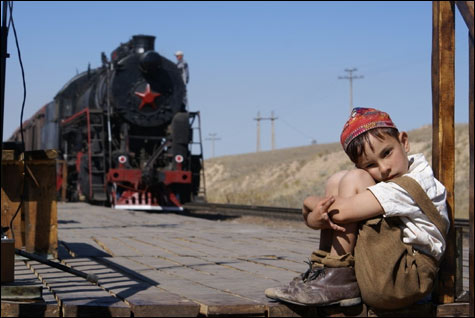
THE GIFT TO STALIN: After seeing Rustem Abdrashev’s Kazakhstan-set film, you’ll feel you’ve been somewhere. |
| “The Boston Jewish Film Festival” | Museum of Fine Arts, Institute of Contemporary Art, Kendall Square, Coolidge Corner, West Newton, Arlington Capitol, Suburbs | Through November 16 |
Now in its 20th incarnation, the Boston Jewish Film Festival is almost the oldest three-ring circus of its kind (San Francisco’s annual program got there first by nine years), and in that span we’ve seen the elusive idea of “Jewish film” become an institution. Just what qualifies a film as Jewish was once a pertinent, and almost unanswerable, question. Today, as the BJFF has defined it, a Jewish film is one that intersects in any meaningful way with diasporic culture, be it in Tel Aviv, London, Auschwitz, or Hollywood. It’s a global agenda, expansive instead of qualifying.And it’s worth noting that 2008 seems to be rounding up as some kind of Israeli bumper crop, beginning with Etgar Keret & Shira Geffen’s Jellyfish, David Volach’s My Father, My Lord, and Amos Gitai’s One Day You’ll Understand [Plus tard tu comprendras] (this last one is included in the program: ICA: November 8 at 9:15 pm; Coolidge Corner: November 9 at 9 pm). Are we finally detecting the first gurglings of an overdue Israeli New Wave? It’s hard to tell just yet, but in any case this year’s BJFF catalogue is rich and surprising.
The most mediocre film I saw is the formulaic and expertly calculated NOODLE (2008; Coolidge Corner: November 8 at 7 pm; MFA: November 15 at 9 pm), a schmaltzy Israeli sniffler in which a lonely but lovely Tel Aviv widow (Mili Avital) is stuck with a six-year-old boy after his mother, the widow’s cleaning woman, is deported. You know where it’s headed: maternal aches, cute intercultural exchanges, outrageous heroism, big tears. Still, adroitly harpooning middle-class audiences’ tear ducts is far from an unpardonable crime.
Erez Tadmor & Guy Nattiv’s STRANGERS (2007; Coolidge Corner: November 8 at 9 pm; MFA: November 9 at 7:30 pm; Kendall Square: November 13 at 9 pm) is also less than daring, an improvised, pretentious romance between a sexy Parisian Palestinian woman and an Israeli hunk who meet clumsy-cute in Berlin, where they’ve come to see the 2006 World Cup final (just as the Israeli war against Hezbollah heats up on the news). Of course they fuck and then separate, and then her little son creates crises for both, and their efforts to have their affair remain a one-night stand are thwarted. It’s nothing new, but the actors are fine, especially Lubna Azabel (Viva Laldjerie, Changing Times, Body of Lies), and the hand-held textures are authentic.
 Related
:
Avoiding a border war, Review: Eli and Ben, Review: Within the Whirlwind, More 
- Avoiding a border war
It's a matter of moments before the likes of Lou Dobbs and Bill O'Reilly scapegoat the believed-to-be-illegal-immigrant suspects in last week's Brookline rape case for every problem in America.
- Review: Eli and Ben
Unlike most opening-night crowd pleasers, Ori Ravid’s thoughtful coming-of-age tale starts off the Boston Jewish Film Festival with some ambiguity and edge.
- Review: Within the Whirlwind
Those eager to compare the Obama administration to a Communist dictatorship might check out this story based on the memoirs of the poet Evgenia Ginzburg.
- Review: A Matter Of Size
Director duo Sharon Maymon and Erez Tadmor have fashioned a look at a group of blue-collar Israeli men and how they came to accept who they are.
- Independence and assimilation at the 2010 Boston Jewish Film Festival
Independence and assimilation at the Boston Jewish Film Festival
- Review: Jerusalem Pita & Grill
Our first real review of the new year, and already we are ticking off one of last week’s resolutions for restaurateurs.
- An (almost) A-to-Z guide to Boston
Welcome to Boston, college kids.
- Strange world
Bob Pfeifer's debut novel, University of Strangers (published by Power City Press, the print arm of the punk label Smog Veil Records), is a fictionalized retelling of a sensational, true-life murder case, as related in the voices of real people.
- Review: Orgasm Inc.: The Strange Science of Female Pleasure
For nine years, Vermont-based filmmaker Liz Canner raced around the country with her camera doing research and interviews for this exemplary, absorbing, muckraking documentary.
- Review: The Arbor
Andrea Dunbar turned her smothering, abused, and abusive life in a West Yorkshire housing project into a series of raw autobiographical dramas, and, as a teen playwright in the '80s, she became a star in London with acclaimed productions of The Arbor and Rita, Sue and Bob Too — the latter an excellent film, as well.
- A new trio hits the Coolidge
Soloff, now 67, has a long list of impressive credits that includes the Carla Bley Band, the Carnegie Hall Big Band, the Vanguard Jazz Orchestra, a passel of Latin jazz bands (including Machito's), seminal jazz-rock outfit Blood, Sweat, and Tears, and a long association with the man he considers his mentor, composer/arranger Gil Evans.
- Less

Topics:
Features
, Nazi Party, Communism, Andrew Jacobs, More
, Nazi Party, Communism, Andrew Jacobs, Coolidge Corner, Mili Avital, Viggo Mortensen, Hezbollah, Amos Gitai, LL Cool J, Meg Ryan, Less
