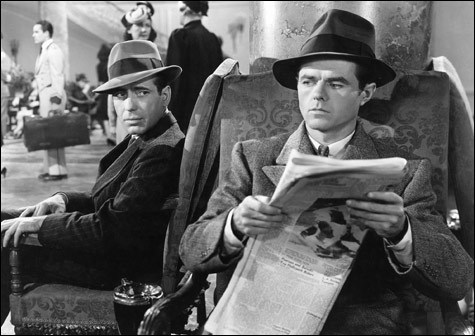
THE MALTESE FALCON: How did Elisha Cook Jr.’s homosexual Wilmer sneak past Joseph Breen’s watchdogs? |
| “Film Noir and the Production Code” | Museum of Fine Arts: June 4-27 |
"At heart, film noir was Code splintering. The dark genre sabotaged the sunny optimism of Hollywood cinema with a gloomy weltanschauung smuggled in by foreign-born agents like Fritz Lang, Billy Wilder, Robert Siodmak, Otto Preminger. . . . Film noir was the un-American activity in Hollywood that the U.S. Congress should really have been investigating."That's Brandeis American-studies professor Thomas Doherty writing in Hollywood's Censor: Joseph I. Breen and the Production Code Administration. The Production Code, Hollywood's notorious self-censorship program, was instituted by the Motion Picture Producers and Distributors of America in 1930, but it didn't go into effect till 1934, when it was administered by Joseph I. Breen. The Code (popularly known as the Hays Code, after its original, lame-duck supervisor, Will B. Hays) severely restricted Hollywood's portrayal of sex and violence, but it grew more flexible in the years following World War II, and by the mid '60s it had become obsolete. (The MPAA ratings system was its official replacement.) The seven movies screening in the Museum of Fine Arts' "Film Noir and the Production Code" series this month show how film noir — that most brutal and anti-social of genres, the embodiment of the forbidden fruit the Production Code framers were afraid movies would tempt audiences to covet — challenged the Code in the '40s and '50s.

Not all these films are true noirs: the latest one, ANATOMY OF A MURDER (1959), is a courtroom drama, and GILDA (1946) is a cut-rate romantic melodrama. Both were, I presume, included because they offer femme fatales: the title character in Gilda, played by Rita Hayworth (who, in the film's highlight, performs "Put the Blame on Mame"), and Laura Manion (Lee Remick), the flirtatious wife of the soldier (Ben Gazzara) in Anatomy of a Murder whom Jimmy Stewart's homespun small-town lawyer defends for murdering the man who had beaten and raped her. There are four classic noirs: THE MALTESE FALCON (1941), DOUBLE INDEMNITY (1944), THE BIG SLEEP (1946), and TOUCH OF EVIL (1958). And there's perhaps the most bizarre of all '50s noirs, KISS ME DEADLY (1955), which was adapted from a Mickey Spillane novel. In John Huston's The MalteseFalcon, a number of people die for "the stuff dreams are made of," a gold statuette that keeps eluding its obsessed, ruthless seekers. In Kiss Me Deadly, the object of everyone's desire, known as "the great whatsit," turns out to be a Cold War version of Pandora's box.
Doherty, who has written so eloquently about the Code in his books Pre-Code Hollywood and Hollywood's Censor (and who will introduce the June 4 screening of The Maltese Falcon), is on the money when he suggests that noir was the inherent enemy of the wholesome values the Code sought to protect. James M. Cain, who wrote the novel on which Double Indemnity was based, was considered unadaptable throughout the '30s; the fact that Breen's office allowed Wilder to film the corrosive screenplay he and Raymond Chandler came up with indicates how much times had changed (and the war had changed them). Cain's sordid narrative is a fable in which lust and greed not only corrupt the protagonists — moist-lipped blonde seductress Phyllis Dietrichson (Barbara Stanwyck) and insurance salesman Walter Neff (Fred MacMurray), who falls in love with her and kills her husband in a plot to snag his accident-insurance money — but eventually turns them against each other. In the words of Neff's hero, the claims investigator Barton Keyes (Edward G. Robinson), it's a trolley they can't get off until it reaches its destination — the cemetery. But the way in which the movie punishes these murderous adulterers doesn't mitigate the vicarious pleasure we take in their behavior, anymore than the fated fall of the cocksure hoods did in pre-Code gangster dramas like The Public Enemy and Scarface.
The world of the noirs, where the characters act on their darkest and most irrational impulses, exiling themselves from the moral comforts of community, is depicted most potently in Double Indemnity and The Maltese Falcon. Humphrey Bogart's San Francisco shamus Sam Spade isn't a dupe like Walter Neff; in the conventional private-eye noirs, which look to Dashiell Hammett and Chandler rather than to Cain for their inspiration, the hero may fall for the femme fatale, but she doesn't destroy him. Spade holds onto his principles: he turns Brigid Shaughnessy (Mary Astor) over to the cops for murder because her victim was his partner, Miles Archer, and though he didn't even like Archer very much, when your partner is killed, you're supposed to do something about it. So the Hays Office gets its moral happy ending, and no one benefits from the much-sought-after solid-gold falcon, any more than the characters benefit from the gold dust that liberates the monster in Bogart's Fred C. Dobbs in a later Huston masterpiece, The Treasure of the Sierra Madre.
