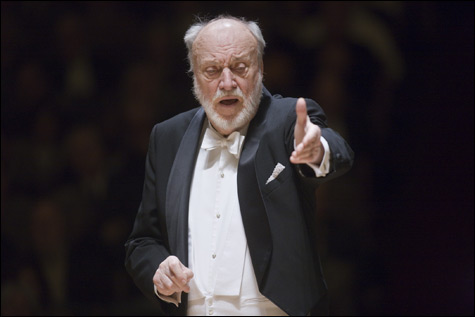
BICENTENNIAL TRIBUTE: Kurt Masur's BSO Mendelssohn was expert but had neither sparkle nor mystery. |
Anniversaries, however fabricated, can still be useful. This year commemorates the 200th birthday of Felix Mendelssohn, the 150th birthday of Victor Herbert (both recently celebrated with intensive "orgies" on WHRB), the 200th anniversary of Haydn's death, and the 250th anniversary of Handel's death. Two major Boston institutions celebrated two of these dates in opposite ways. Eighty-one-year-old New York Philharmonic music director emeritus/Leipzig Gewandhaus conductor laureate Kurt Masur, a frequent Boston Symphony Orchestra guest conductor since his 1980 debut here, led Mendelssohn's popular TheHebrides Overture and his two best-known symphonies, No. 3, the Scottish (from 1842), and No. 4, the Italian (actually written nine years earlier). Masur is something of a Mendelssohn specialist, and these were expertly and for the most part beautifully played (outstanding solo work by assistant principal clarinettist Thomas Martin), but they lacked any sparkle or mystery.
At the Handel and Haydn Society, on the other hand, artistic adviser Sir Roger Norrington, who made his Boston debut in 1987 leading an unforgettable performance of Haydn's Die Jahreszeiten ("The Seasons"), chose Haydn's L'anima del filosofo, ossia Orfeo ed Euridice ("The Soul of the Philosopher, or Orpheus and Eurydice"), an opera that's probably never been done in Boston — it didn't even get its first performance until nearly a century and half after Haydn's death.

Orfeo dates from 1791, the year of Mozart's Masonic comedy, Die Zauberflöte ("The Magic Flute"), and his last "serious opera," La clemenza di Tito ("The Clemency of Titus") — also the year he died. Haydn's opera seria is saturated with similar Enlightenment ideas about reason and self-control. Like Mozart, Haydn tried to revivify this dated and stilted form, but with less success. Orfeo eschews drama for philosophizing (Eurydice is lost barely after you realize she's been saved), and it comes to life in fits and starts rather than as a unified whole. Still, there's some masterful music that includes the final chorus of Bacchantes being washed out to sea in a ferocious storm (thanks to timpanist John Grimes and H&H's trumpets and trombones) after they've slaughtered Orpheus, the opera's last notes disappearing in the distance.
American soprano Sarah Coburn has a strong and beautiful tone, like topaz, and a superb coloratura technique. Unlike the usual pipsqueaky coloratura, Coburn's voice actually increases in color as it pinwheels up the scale. She brought down the house twice. She also made a dramatic distinction between the tender Eurydice and the almost gossipy Sybil who escorts Orpheus into the underworld to reclaim his dead wife.
British Tenor Andrew Kennedy has intelligence and a pleasant if not especially beautiful or distinctive sound. His best moment was in a kind of mad scene after Orpheus loses Eurydice the second time. Most impressive was British baritone Christopher Maltman, with his powerful, richly textured voice and imaginative phrasing as Eurydice's father and Pluto. Christopher Krueger had some ravishing music for flute and John Finney was the expressive fortepianist accompanying the recitatives. The chorus, all-important here, was also superb. It's hard to imagine a conductor whose phrasing and wit and sense of musical architecture could make a better case for this piece than Sir Roger. One crucial thing missing, especially for such an obscure work, was a translation of any sort — H&H had no supertitles and offered no printed text. I heard many complaints. Some cost cutting can be really counterproductive.
The following Saturday afternoon, I saw an earlier but greater Orpheus opera, Gluck's, in one of the Metropolitan Opera's live telecasts in HD. Wittily staged and choreographed by Mark Morris and lovingly conducted by James Levine, this was a most enjoyable event. These live telecasts are becoming more skillful, especially when the productions themselves are good. Puccini's La rondine (with Angela Gheorghiu) and Massenet's Thaïs (with Renûe Fleming) were more satisfying recent experiences than any of the telecasts I saw last year. The TV close-ups actually helped clarify the Met's mediocre and confusing production of the John Adams/Peter Sellars Doctor Atomic back in November.
Orpheus was impressive Met mezzo-soprano Stephanie Blythe, though at Levine's fast tempo, Orpheus's heartbreaking aria, "Che farò senza Euridice" ("What shall I do without Eurydice"), didn't break my heart. Morris had the inspired idea of having the onlooking chorus dressed as iconic historical figures (Cleopatra, Abraham Lincoln, Gandhi, Maria Callas) — the dead observing and commenting on the action. Having Orpheus play a guitar, however, just seemed silly. Heidi Grant Murphy was a most amusing Amor, though she wasn't in good voice. Eurydice was 29-year-old Australian (of Dutch/Sri Lankan heritage) soprano Danielle de Niese, who in her youth won an Emmy as host of an LA arts showcase for teenagers. She's exceptionally pretty and sang prettily; you could see why Eurydice was such a profound loss to Orpheus.
