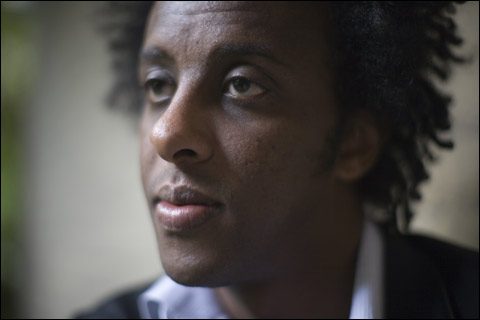
GROWING PAINS: Whereas Mengestu’s previous novel looked at newly arrived immigrants, this one is about a second-generation character who is “deeply, thoroughly American.” |
Seriousness sets Dinaw Mengestu's work apart from most novels about the immigrant experience. Lesser writers exoticize their foreign-born characters to the point of caricature, pandering to their presumed audiences by according immigrants special wisdom or a greater capacity for loud, zany fun. With any luck, Mengestu — along with Jhumpa Lahiri and Salvatore Sciabona, whom the New Yorker has also identified among the nation's best young novelists — will kill the wise, wacky immigrant novel once and for all.
The Beautiful Things That Heaven Bears, his 2007 debut, was a moving, intelligent work about the struggles of an Ethiopian immigrant convenience-store owner. Reviewing it for the New York Times, Rob Nixon called it "a great American novel." The book was translated into other languages. When Mengestu visited Paris for the release of the French edition, he fell in love with the city, moved there, and started a family.
His second book, How To Read the Air, came out last week from Riverhead. The novel follows an aimless young Manhattanite named Jonas as he looks back at the fraught marriage of his traumatized immigrant parents in Peoria, Illinois. Mengestu is familiar with both settings; he received his MFA from Columbia University and was raised in a northwest Chicago suburb. (Full disclosure: we went to high school together.)
"I certainly didn't spend a lot of time thinking I wanted to write a larger book, but I certainly wanted it to be a bit more expansive," he tells me from his New York hotel room at the start of a US book tour that brings him to Brookline Booksmith on Monday. "I think part of that was my natural evolution as a writer. You don't want to tread water in the same place."
Part of the expansion is an American-born protagonist. "I didn't want to continue the idea of the newly arrived immigrant. I wanted somebody who was very deeply, thoroughly American, but who in some way is deeply attached to his parents' past and a foreign landscape — just to see if I could make those two things collide inside of one character."
This collision manifests itself in Jonas's palpable, if unintentional, hostility toward others. As the novel begins, he's rewriting refugees' accounts of their persecution for an NGO that helps them gain citizenship. At his boss's behest, Jonas bends the facts, and he has little problem doing so. "Part of it is cynicism," Mengestu explains. "It's the awareness that the truth is very malleable, especially when it comes to narratives concerning immigrants, or migrants, or refugees — there's a certain repetitiveness that happens, and I think the cynical side of him is willing to give in to the fabrication because he knows what the reception is generally going to be."
The reader learns that Jonas's cynicism comes, in part, from his father's violence. "I didn't want to have everyone be sweet, tender people you feel warm and fuzzy about," Mengestu continues. "I wanted repercussions in immigrant life and the way that transforms from one generation to the next. The other part of it [Jonas's habit] is lying as a defense mechanism and a way of managing reality. He hides and is able to shelter himself in his fictions. It's a way of avoiding things that are difficult. The stories that he creates for his class are ways of figuring out exactly who he is."
