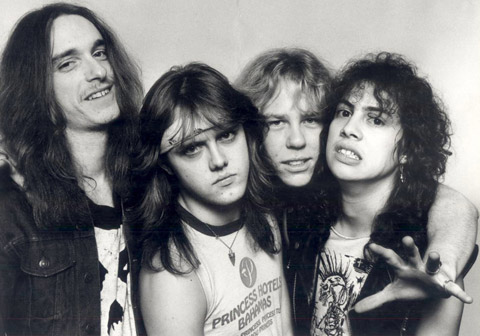
CREEPING DEATH The other three (Ulrich, Hetfield, Hammett) were gifted metal oiks, but Cliff Burton (left) was a musician, schooled in theory, transmitting from a private universe of inspiration and expertise. |
That the biggest metal band in metal history should be called METALLICA — it's just so frigging metal. Other musics proclaim themselves less nakedly: a group of beards with lutes and crumhorns is not Folkzilla, and Miles Davis never ran his quintet under the name Jazzmungous. But metal wants shouts of allegiance, the louder the better — verbal burnt offerings. And the gods of metal, once honored, are generous. They are bounteous. Live it, do it, and they will reward you. Which is how come the four leering pubes in the back cover shot of 1983's Kill 'Em All, horribly coiffed and zit-insolent, were at that moment, through sheer devoted metalheadedness, well on their way to being the heaviest band on Earth.Let's parse that heaviosity a little. By the time the wider world became aware of them, around the release of Master of Puppets (1986), the heaviness of Metallica was, in a sense, extra-musical. It was commercial, it was cultural: absent from TV and radio, this band were nonetheless selling millions of records, playing stadiums, uniting estranged constituencies of punks and metallers, getting tons of press, and seriously challenging the mainstream. Apparently they represented "thrash" or "speed," while having already exceeded those labels, and they brought with them an atmosphere of specialized severity. It was in James Hetfield's piggy eyes and deadened downstrokes; in the ranks of white crosses on the album cover; in the brushed, frowning acoustic chords that introduced "Battery." The producer had a Nordically heavy name (Flemming Rasmussen!) And there was tragedy, too: Cliff Burton, the bassist, had just been killed.
For rock journalist Mick Wall, the death of Burton in a bus crash on an empty Swedish road is the crux event. Preceded by other Metallimoments — the meeting of Lars Ulrich and Hetfield, the firing of Dave Mustaine, the poaching of Kirk Hammett from Exodus — it dwarfed them all in respect of a) finality and b) artistic significance. Enter Night, Wall's new Metallibio, opens in medias res: "From the rear emergency exit came the singer, tall, deranged . . . just in his underpants and socks, yelling and screaming, bloody of mind, followed by the guitarist, another short skinny-arsed figure, coughing and crying, his large dark eyes full of night sky and ashes."
That's some heavy-metal writing, is it not? And appropriately so: Burton, in Wall's telling, was "the soul of the band," and his death beneath the overturned bus a drastic closure of possibility. Cliff — in his flares, with his solos — looms semi-gigantically over this story; a beautiful stoner, a very serene headbanger, rich mane above plunging beak as he wrist-whacked his bass-strings impatiently for extra snarl. The other three were gifted metal oiks, but Cliff was a musician, schooled in theory, transmitting from a private universe of inspiration and expertise. "Bach is God!" he would declare during the recording of Ride The Lightning, and the gorgeous intro to "Damage Inc." on Master of Puppets — those gentle, fathoms-deep volume surges and spirituous twists of melody — was Burton's variation on a Bach aria called "Come, Sweet Death." (If you're feeling, right now, like getting a bit Cliff'd-up, allow me earnestly to recommend Rodrigo y Gabriela's version of "Orion".) He introduced his bandmates to the Misfits and HP Lovecraft. On another level, he was the band's bullshit detector.
