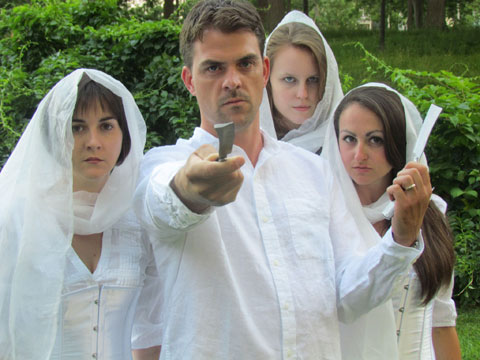
TO THE SLAUGHTER Playing out the horrors of Macbeth. |
Theater's al fresco season is upon us, and once again the Fenix Theatre Company regales us with a Shakespeare classic as we nestle against a hillside in Deering Oaks Park. This year brings a slight change: After several seasons of staging the Bard's comedies, this year the company presents what is perhaps Shakespeare's most psychologically horrific tragedy, Macbeth. From now through August 11, the Scottish play runs on Fridays and Saturdays in the park, as well as Thursdays in the quad of Bowdoin College, with Rob Cameron as the title murderer and Abigail Killeen as the wife who drives him to it.
Director Bryant Mason stages Macbeth's fall in the same general area as last year's Waiting for Godot, on and around the footpath at the base of the northeast slope of the pond. It's a beautiful spot, though the green openness of the space presents something of a challenge as a setting for Macbeth: Part of the play's terror is in its obsessive psychological claustrophobia, and some of that taut, close energy dissipates in the park's urban-pastoral spaciousness (as do a few lines played from too far off stage left).
An ethereal kind of weirdness is conjured by the production design, most notably by Molly Bryant Roberts's cleanly stylized costumes: Everyone is dressed in immaculate white. The nobles are in linens, Lady Macbeth in a strapless gown, and the weird ladies themselves (Brittany Cook, Allison McCall, and Roberts) in gauzy headdresses, corsets, and red sashes. Much of the staging follows stylized suit: The witches are often as still and composed as classical statues or oracles, and characters are killed not in realistic bloodbaths but by ritualistic entwining in the red sashes. It's visually striking, though overall the production holds some stylistic inconsistencies: the red sashes present a metaphorical rendering of murder, while Macbeth brandishing a gleaming meat cleaver is rather more literal a threat.
The key victims of his murders, Duncan and Banquo, are both played as women (Sally Wood and Susan Garrett), as is the drunken porter (Maureen Butler) who also gets the knife. Small bits of staging encourage us to actively think of them as women — when Macbeth teases Banquo about the witches' prediction for her children, he makes a jocular gesture toward her belly. It's an interesting directorial decision: Gender-blind casting is common practice, though it's also true that Lady Macbeth is ordinarily one calculating woman amid many men, with the witches as the only other major female force. To make the victims of Lady Macbeth's murder-by-proxy into women is to change a fraught gender-driven tension, and it might have been interesting to see Killeen's Lady as driven in part by rivalry with those of her own sex; as it is, the gender tension is essentially neutralized. That said, Wood gives Banquo an endearing humor and common decency, and it is always a pleasure to watch Butler stumbling around as the drunken comic relief.
