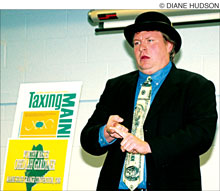
 Now that the contentious Taxpayers’ Bill of Rights has made it to Maine’s fall ballot, you can expect to hear even more about the only phenomenon that Ben Franklin deemed as reliable as death. To help keep these discussions from also being as entertaining and nuanced as death, the Maine Humanities Council has commissioned Taxing Maine, a two-man educational road show written by the Theater at Monmouth’s producing director, David Greenham. A sort of stand-up people’s history of Maine taxes, Greenham and fellow actor Dennis Price present us with both the reasons and the passions behind the rates.
The aim of Taxing Maine is to move the discussion beyond the knee-jerk “Cut Spending” chant that tends to dominate the debate, and which will surely inform discussions about TABOR. (Similar to the initiative that voters passed in Colorado in 1992, only to suspend it again last year, Maine’s TABOR would cap government spending, allowing increases only at the rate of inflation and population.) Greenham and Price point out that the more responsible and difficult conversation must address the question of what we, the people, value. During the five months between now and Election Day, Greenham and Price will travel to libraries, schools, and town halls throughout the state, bringing Maine voters a brief, free history of the state’s taxes. Then, at the end of each show, Greenham and Price will open the floor to the audience for an open discussion about how we feel about our taxes, just what constitutes “the common good,” and how much we are willing to pay for it.
In easygoing slapstick/stand-up manner, the duo of Taxing Maine gives us the back story of the state’s three main forms of taxation: property (old as the hills, and inherited from England), sales (an idea got handed to us by, believe it or not, the Live Free or Die State), and income (originally pushed by the agricultural Grange Movement, to shift the tax burden off of farmers and onto the market’s “monopolists” and “middlemen” making a killing from their products).
Greenham and Price deliver all this information brightly, with plenty of silliness to temper the fiscal facts. Each segment on the three main taxes is introduced with a nod to its faux “sponsors.” (One that got a particularly good laugh was Dirigo, “providing affordable health care to dozens of Mainers.”) Big cards on stands illustrate dates and names, and the two actors bumble in and out of simple costumes in accordance with whom they’re quoting — coats and felt hats for Maine’s elder statesmen, overalls for farmers, black-tape mustaches for the cackling New Hampshire politicians (one of whom cheekily clutches a hunk of granite). They’ve plumbed old documents for exposition and great quotes, like this one from early 20th century Mainer politician Obediah Gardner: “Civilization and taxes go hand in hand. They are the difference between civilization and savagery.”
