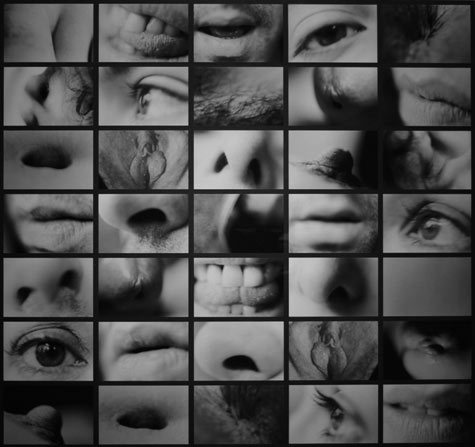
PORTRAIT PARTIALS: Carolee Schneemann’s catalogue of holes and orifices raises questions
about the objectification of bodies. |
“Carolee Schneemann” Pierre Menard Gallery, 10 Arrow St, Cambridge | Through November 25 | “Hannah Barrett: The Secret Society”
Howard Yezerski Gallery, 14 Newbury St, Boston | Through October 30 | “Morton Bartlett: Family Considered”
Danforth Museum, 123 Union Ave, Framingham | Through October 27 | “Alexander Apostol: In Lieu Of Modernity” Space Other, 63 Wareham St, Boston | Through November 7 | “Martin Creed: The Lights Going On And Off” Boston Center For The Arts, 539 Tremont St, Boston | Through October 28 |
Carolee Schneemann is one of the grandes dames of the ’60s and ’70s feminist art revolution. In her landmark 1975 performance Interior Scroll, she stood naked and read about sexism from a three-foot-long strip of paper that she pulled out of her vagina. The action was visceral and elemental. Also unforgettable.Despite her pioneering role, her work is not often seen. Which is why her mini career-spanning survey at Cambridge’s Pierre Menard Gallery is a must, even though it’s a mixed bag. (Interior Scroll isn’t presented.) Schneemann, who’s based in New Paltz, New York, has long favored a let-it-all-hang-out Abstract-Expressionist-assemblage-happening style; this can build to affecting moods, but sometimes it feels like a pointless jumble. What sets her apart is the way she puts her body into the middle of her work, and her political and feminist subjects.
“Fuses” (1964-’67), a 30-minute self-portrait film of Schneemann and composer James Tenney making love, is a raw, tender, joyful, and slightly aimless montage of kissing, smiles, city lights, a penis, a vulva, a cat, oral sex, naked bodies rolling around, pumping, scratched distressed footage, dancing abstract blobs, stars. In “Body Collage” (1967), Schneemann slathers her naked body with paste and rolls in shredded paper. At first it seems an arty ritualistic goof, but it becomes unsettling as the paper stuck to her body begins to look like bandages.
Portrait Partials (1970) is a sexy, sweet, intimate grid of close-up black-and-white photos of her own eyes, lips, vulva, nose, and nipples and some guy parts. It’s a catalogue of holes and orifices seen the way a lover might; at the same time, it raises questions about the objectification of bodies.
The recent work is less interesting. In Dark Pond (2001-’05), she scrawls pencil, watercolor, and crayon across photos of people plummeting from the World Trade Center on September 11. It’s unaffecting because it doesn’t connect the abstract doodling with the tragedy. Her eight-minute video “Devour” (2003-’04) is a montage of a demolition derby, soldiers exiting a helicopter, a jetliner landing, bloody corpses, a suckling baby, a cat kissing a woman’s lips. It adds up to an ominous but bland fugue.
