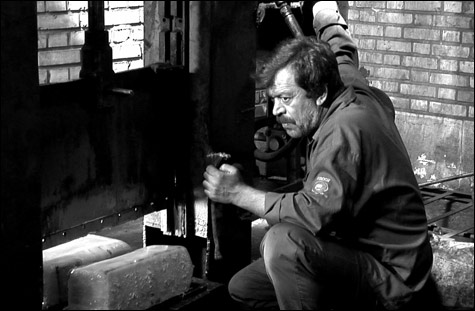
A MAN WHO ATE HIS CHERRIES Director Payman Haghani suggests the more fundamental evils underlying the Iranian regime's religious intolerance. |
You can see what is probably the most significant filmmaking right now in Iran by going to YouTube and viewing the artless images of brutality in the streets of Tehran captured by scores of average Iranian citizens armed with cell-phone cameras. This repression has also decimated the ranks of professional directors. Jafar Panahi has been shut down from making films since Offside in 2006, and Mohsen Makhmalbaf resides in virtual exile in Paris (where he operates a blog updating the world on the latest developments in his homeland). Small wonder, then, that this year's Boston Festival of Films from Iran at the Museum of Fine Arts is a shadow of its former self, reduced to five features (three of which, including new films by Abbas Kiarostami and Samira Makhmalbaf, were unavailable for screening), a few documentaries, and some shorts.
It's nonetheless clear that this film industry has maintained its integrity as it turns out humanistic and æsthetically ambitious works. Rather than confronting the most egregious injustices, Iranian cinema regards them indirectly, through metaphor or analogy.
One way to avoid trouble with the authorities is to make a film about people who have it even worse off than yourself, people everyone can agree are getting a raw deal, like illegal immigrants. The eponymous hero of Shalizeh Arefpour's HEIRAN (2008; January 15 at 8:10 pm) is a young man studying in Tehran. To make money for tuition, he's been working as a laborer in a village near the Afghan border. There he crosses eyes with teenage Mahi, whose war-stricken parents want her to get an education. Her father doesn't want her to waste her life on a refugee, but she marries him anyway, whereupon fate and a heartless bureaucracy conspire against them. Arefpour has a sly command of touching details, and he knows how to jerk some genuine tears.
More stylistically ambitious is Payman Haghani's A MAN WHO ATE HIS CHERRIES (2009; January 17 at 3:30 pm). A kind of Iranian film noir shot (mostly) in black and white, it relates the sad tale of Reza, a hangdog factory worker who returns home late from work one night and finds that his long-suffering wife has left him. Not only that, but she plans to get a divorce and extract an astronomical settlement from him. The extreme measures Reza ponders to pay his debt embody the notion of the alienation of labor, and Haghani's detached but mordant case study suggests that underlying the regime's religious intolerance are more fundamental evils: greed, exploitation, and dehumanization.
Maziar Bahari's AN IRANIAN ODYSSEY: MOSSADEGH, OIL, AND THE 1953 CIA COUP (2009; January 9 at 7 pm) does deal directly with a real political crisis — if more than 50 years later. A conventional but illuminating documentary, it relates how the British and the CIA deposed the nationalistic Iranian prime minister Mohammad Mossadegh and established Shah Mohammad Reza Pahlavi in power. This little-known historical turning point set the stage for the 1979 Iranian revolution that overthrew the shah and established the reign of the ayatollahs.
A Canadian-Iranian filmmaker, Bahari had been detained by Iranian authorities while reporting on the current turmoil. He was released in October and will attend the festival and receive its ILEX Foundation Award for Excellence in Iranian Cinema. Watching the archival footage in his film, you have to wonder whether someday a filmmaker like him will turn those YouTube images of the bloodied streets of Tehran into a similar documentary, and whether that too will take five decades to happen.
