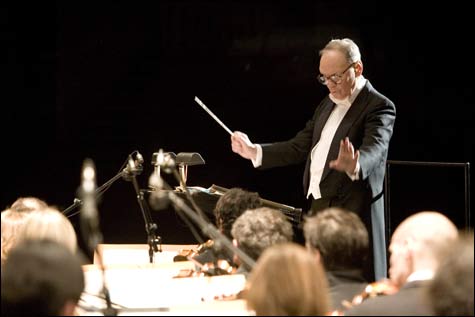
MAESTRO It’s impossible to classify the range of Morricone’s music, or the range of the people who turned out to see him. |
Some years ago in these pages Mark Moses wrote that he couldn’t imagine there was ever a time when “My Girl” didn’t exist — even though he was born before the song was recorded. Listening to the theme from The Good, the Bad and the Ugly at Radio City Music Hall last Saturday night during composer Ennio Morricone’s US concert debut, I knew exactly what he meant. That combination of weird echoing whistle (on the subway ride home, when a stranger heard me mention the film’s title, he broke into that whistle) and stark electric guitars (the sound of switchblades vibrating under water) has, for many of us, been there for as long as we’ve been aware of music.And yet, before it, who could ever have imagined a Western sounding like that? This was not an adaptation of Western or folk songs, or some sweeping score by the likes of Dimitri Tiomkin or Hugo Friedhofer. The score even predated the way electric guitars would sound in the wake of Jimi Hendrix. It was weirdly fitting, though, the sound of a landscape that was both vast and breathing down your neck, the promise of emptiness and doom.
With more than 400 film scores to his credit, it was impossible for Morricone, who at 78 will receive an honorary Academy Award at the end of this month, to satisfy the wishes of everyone who came to hear him with the Roma Sinfonietta Orchestra, the Canticum Novum Singers, and the New York Virtuoso Singers. Which is appropriate, because it’s impossible to classify the range of Morricone’s music, or the range of the people who turned out to see him.
Morricone grouped the music into suites. There were selections devoted to his music for Leone (from the acid guitars of the early Westerns to the lush memory play of Once upon a Time in America) and Giuseppe Tornatore (Cinema Paradiso) and to the orchestrated Italian pop of the ’60s. A knockout titled “Social Cinema” combined the mournful theme from Brian De Palma’s Casualties of War and “Aboliçâo,” the stirring main title theme from Gillo Pontecorvo’s Burn!
This last was, for me, the highlight of the night, the selection on which the sheer force of 200 persons on stage (half in the orchestra and half in the chorus) could be most felt. Beginning from a piping organ riff, bongos, and one of the maestro’s signature stark guitar lines, the composition adds the chorus singing the one-word title over and over, male separated from female, higher range from lower, until the meshing voices crescendo to a climax that’s emotionally overwhelming. Far more movingly than Pontecorvo’s problematic film, the music provides a dramatic precis of the themes of struggle, revolt, and triumph.
