Teatro Lirico II at Cutler Majestic Theatre, March 1, 2008
By JEFFREY GANTZ | March 4, 2008
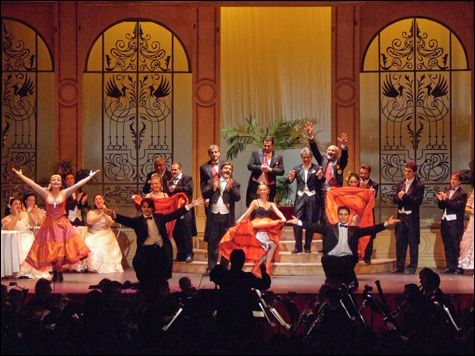
DIE LUSTIGE WITWE: Like the Pontevedro without Hanna’s millions, this production was a little
shabby and threadbare but nonetheless good-hearted and, in the end, hard to resist. |
It’s never a good sign when a company can’t get the name of the work it’s performing right. The program cover for Teatro Lirico d’Europa’s presentation at the Cutler Majestic Theatre on Saturday did read, The Merry Widow, but inside, the original German title appeared as Die lustige Weiber rather than Die lustige Witwe. Perhaps the usually reliable (and perhaps overextended) Bulgarian troupe still had Franz Lehár’s catchy “Weiber” chorus ringing in its ears. Or perhaps it had confused Lehár’s hit 1905 operetta with Otto von Nicolai’s 1849 opera adaptation of Shakespeare, Die lustigen Weiber von Windsor.That wasn’t the end of the program puzzles. Camille de Rosillon was to be sung by “Gueorgui Dinev” and Njegus by “Guergui Dinev.” However you spell it, there’s just one Georgi Dinev at Teatro Lirico (I believe he sang Frosch in the Fledermaus the company brought here in 2005), and there’s no way any performer, however accomplished, can play both roles because Camille and Njegus are on stage at the same time and even sing together. There was a pre-curtain announcement that “Paul — ” would be singing Camille; I didn’t catch Paul’s last name, and though I was sitting in the fifth row, I didn’t hear much of his whispery singing, either.
Operetta, with its more modest vocal demands, might seem easier to stage than opera, but it isn’t: everyone has to look good and move well and enunciate and glitter and be gay. The best productions of Die lustige Witwe I’ve seen, both in 2003, were from the Komische Oper in Berlin and New England Light Opera here in Boston; the worst, in 1999, was at the Met, with a static Plácido Domingo and Frederica von Stade. Like the Komische production, this one was presented in the original German (American companies usually do The Merry Widow and Fledermaus in English); the jokes are better, but the subtitles have to keep up, and these didn’t, being out of synch when not missing altogether. (When Baron Zeta finds what he doesn’t realize is his wife’s fan, reads the words “Ich liebe dich” written by her lover, and snorts that the woman’s husband must be an idiot, his clerk, Njegus, mutters, “Das hat er recht!”; “He got that right!” should appear on the screen, but there was nothing.) “Discreet” — a key word in an operetta about sexual diplomacy — was invariably misspelled “discrete.” Enunciation was poor as well.
 Related
:
A Violetta to die for, The good old days, Opera superstar 101, More 
- A Violetta to die for
Ukrainian soprano Marina Viskvorkina gave an extraordinary performance as the consumptive courtesan Violetta Valéry.
- The good old days
As if it weren’t enough that the venerable Paramount Theatre on Washington Street was open for the first time since 1976, the Celebrity Series of Boston brought in as the initial act to play the new 600-seat mainstage Max Raabe and his Palast Orchester.
- Opera superstar 101
Domingo put his arm around Martínez and whirled her around the stage, asking the audience to sing in their stead.
- Everybody in!
Randy Randall has a cold. To be precise, a debilitating throat infection picked up on a plane somewhere over the Pacific.
- Zedek’s æsthetic
Thalia Zedek is hunched over a pint at the Cambridge Brewing Company, looking a bit like a grizzled veteran of some sort of mythical rock-and-roll war.
- Jimmy Page: After the Yardbirds...
This article originally appeared in the February 5, 1969 issue of the Boston Phoenix .
- The plot thickens
This article originally appeared in the December 20, 1991 issue of the Boston Phoenix .
- Saving bonds
Moral and ethical quibbles aside, society’s objection to queers amounts to a question of power.
- The marriage of Heaven and Hell
It’s been a joy to see James Levine back on the Symphony Hall podium, with his admirable combination of vitality and sensitivity.
- Theatrics
There’s got to be more to the future than the spectacle of gaudier and gaudier soulless cyberbodies.
- Mega-deluxe edition
Last week, Trent Reznor shocked fans and industry types with the surprise on-line release of a new instrumental album, Ghosts I-IV .
- Less

Topics:
Live Reviews
, Entertainment, teatro lirico d'europa, Placido Domingo, More
, Entertainment, teatro lirico d'europa, Placido Domingo, Franz Lehar, Frederica von Stade, Dance, Performing Arts, Beverly Sills, Orlin Goranov, Ballroom Dancing, Less
