WORD ART Megan O’Connell creates syllables on walls. |
Once Orlando, the eponymous protagonist of Virginia Woolf's novel, awakens from a seven-day slumber to find that he is, in fact, a woman, Woolf sends her into gypsy country. Here, Orlando milks goats, pilfers hen's eggs, and generally relishes the reprieve from the strictures of Englishness. After some gypsy rituals, Woolf sets her alone on an embankment, where during a long and glorious passage we witness Orlando alone and enraptured by nature, awake at last in the full scope of her imagination.
She "liken(s) the hills to ramparts, to the breasts of doves, and the flanks of kine" — an off-duty Duke finding enormous pleasure in doing absolutely nothing — as Woolf unravels a string of inspired metaphors. "Everything, in fact, was something else," Orlando observes. Feeling an urge to write, she makes an ink from berries and wine and, paperless, begins to scrawl in the margins of her poetry manuscript, recording a series of lacerating new insights suddenly available to her about the arrogance of nobility, the confines of gender, and the myth of beauty. It's a triumphant moment; Woolf's words appear to gain enormous power from being composed in a marginal, deterritorialized space. Before long, Orlando realizes a return to England is unavoidable, but she does so irrevocably changed. "I am losing my illusions, perhaps to acquire new ones," she writes.
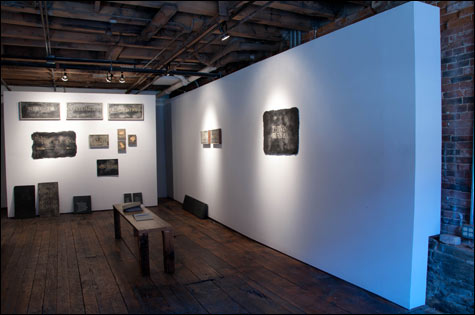
For type artist Megan O'Connell, a critical and artistic interest in the re-framing of textual experience explains that phrase's appearance here. In her exhibition "...are as the poles asunder" (taken from another line of Woolf's concerning the in-between), O'Connell explores the liminal, transformative spaces found in text and literature, such as what produced Orlando's stirring revelations abroad. Mirroring the technique of removing language from its original context and giving it radical new shape and meaning, O'Connell transmutes the printed word into carefully crafted physical tablatures which adorn the walls of Gallery 37-A.
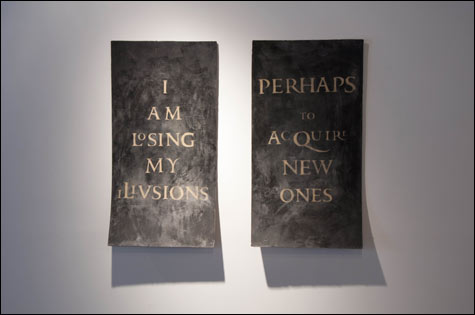 |
Like Orlando's berry ink, O'Connell uses an arsenal of found, constructed, and reappropriated materials in constructing her fragile tablets. The text in the "I Am / Perhaps Diptych" is rendered in Italian beeswax on hand-cast and -carved Dead Skin Press paper, and most other works here follow suit, sparely arranged on the gallery walls and standing along its base. Besides four passages borrowed from Orlando, O'Connell's other texts are comparatively oblique. Her tablets contain fragmentary, untraceable phrases (such as "Hence, True Meridian"), often in Latinate. "Memoria" and "Membrana," another diptych, is rendered in beeswax in an archaic script on a paper mounted on Belgian airplane linen, lending the work a warmer, fattier feel. The artist uses the same process for a triptych ("Next To," "Contained By," and "Remov'd From"), lending the impression that the connotational density of these works matches the material. In "Tabula Rasa," the beeswax text appears to be applied on the dirtiest slate in the room, its handcrafted paper looking nearly charred.
