Anish Kapoor at the ICA
By GREG COOK | June 6, 2008
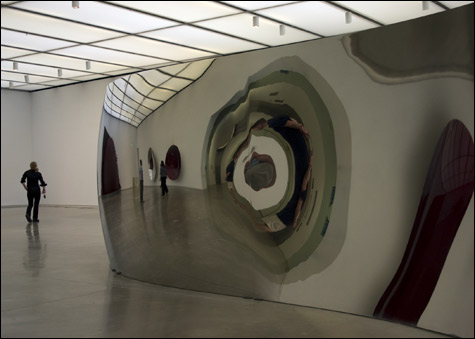
S-CURVE Kapoor evokes the sublime by deploying the sleight-of-hand and spectacle of carnival fun
houses and science-fiction special effects.
|
Over the winter, I made my third or fourth pilgrimage to Anish Kapoor’s Cloud Gate in Chicago. People there have affectionately nicknamed it the “Bean” because it resembles a giant floating bean of liquid mercury that’s drifted down into the middle of the downtown plaza from outer space. Bemused crowds stand around and stare and snap photos and giggle.The 2004 sculpture is Kapoor’s masterpiece, and one of the best public sculptures in the country. It’s a metaphorical gateway arch to the city, tall enough for crowds of people to walk under. Like the best public art, it identifies and then embodies the meaning of its location — in this case a park that showcases the city’s skyline to one side and its lake shore on the other. The sculpture’s polished steel surface mirrors and frames and swallows these vistas, and the people standing around it, like, as a friend says, a giant snow globe turned inside out. The roof inside is concave and operates like a funhouse mirror, warping the reflections of the people underneath and seeming to funnel up into some portal to another dimension.
“The modernist tradition in form is mostly phallic, mostly upward and onward, and it leads to the rocket and the spaceship,” the London artist told me at the Institute of Contemporary Art last week, where “Anish Kapoor: Past, Present, Future,” which is billed as his first major US survey in 15 years, opened on Friday. “I have a feeling that the truly modern — meaning modern of today — the ultramodern form is inside out. And I’m trying to look for it. I try to look for inside-out forms. If one could say there’s a shape to the Internet, I’d say it was inside out. Or rather, involuting.”
The 14 works here — 10 of which, according to the ICA, have never been exhibited in this country before — lay out Kapoor’s primary motifs: velvety pigment-covered geometric and architectural forms, which he focused on from the late ’70s to the mid ’80s; voids or black holes, which became a focus in the mid ’80s; magic mirrors and resin blocks with Rorschach-test bubbles trapped inside, which enter his work in the mid ’90s; and big blobs of sticky red gunk that he’s produced this decade. They’re not as astonishing as the Chicago sculpture (what could be?) but they’re quite fetching.
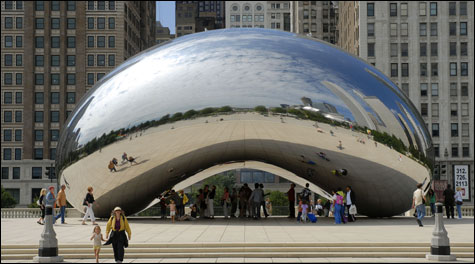
Cloud Gate: LOCATION/DATE Chicago 2004, PROJECT RUNNER-UP Jeff Koons, INSPIRATION l
iquid mercury, COMPOSITION stainless-steel plates, HEIGHT 33 feet, WIDTH 66 feet, HEIGHT OF
“GATE” 12 feet, WEIGHT 110 tons, COST $23 million
|
Kapoor was born in India in 1954 and grew up there. Some detect Indian accents in his work — the elemental geometric forms of an 18th-century Indian astronomical observatory, the vermilion smeared on statues in roadside shrines. But like most artists who came of age in the ’70s, he has as his first language is minimalism. He adheres to its practice of focusing on subtle relationships among simple objects, the viewer, and the space they share. Classic minimalism tends to be difficult, buttoned-up stuff predicated on the notion that if you concentrate on it hard enough and are worthy, you might discover transcendence. What sets Kapoor apart and makes him such a crowd pleaser is that he meets his audience more than halfway, deploying the sleight-of-hand and the spectacle of carnival funhouses and science-fiction special effects to evoke the sublime. This tactic has deep resonances: religions and governments have long used it to impress people, tapping our hardwired drive to invest mysterious forms — cathedral domes, the obelisk of the Washington monument — with major meaning.
 Related
:
Kapoor speaks, Styrofoam sorcery, A certain kind of disorientation, More 
- Kapoor speaks
I believe that what you see isn’t what you see. It’s never what you see. It never was what you see.
- Styrofoam sorcery
They seem like something dreamed up by a mad-scientist Martha Stewart tinkering in her cellar late at night.
- A certain kind of disorientation
Home-grown new sculpture is alive and well right here right now, as Boston Sculptors Gallery regularly reminds us.
- Video vérité
Javier Téllez's 2007 black-and-white film "Letter on the Blind, For the Use of Those Who See" starts with a catchy premise: he gathered six blind New Yorkers at an empty public pool in Brooklyn to act out the fable of the blind men and the elephant.
- Cube root
"I've been told it's the largest single piece of glass in the world," Helen Molesworth, the Institute of Contemporary Art's new chief curator, said at a press preview last week.
- Peabody rising
Could the Peabody Essex Museum be the Boston area’s most exciting art museum right now?
- Year in Art: Beyond the gloom
The Boston art scene felt muted for much of 2008, with 10 galleries closing and the death of two local icons: Harriet Casdin-Silver and Jules Aarons.
- Game show
On November 12, the Institute of Contemporary Art opened its biennial Foster Prize exhibit of “Boston-area artists of exceptional promise.”
- Dullsville
I waited in a crowd for two hours before finally getting into Boston’s new Institute of Contemporary Art on opening day, December 10. Just then a mother rushed out the door, telling her husband and their four little girls, “They say another hour.”
- Vandal-in-chief
Shepard Fairey and his show "Supply and Demand" arrive at the Institute of Contemporary Art like a guerrilla general emerging from the jungle after his forces have taken the capital.
- Beyond dollars and square feet
When the Institute of Contemporary Art revealed specifics of the first 11 acquisitions for its permanent collection a month ago, I watched with particular interest.
- 2009: The year in art
The year started off with a kick in the teeth when, in January, Brandeis University announced plans to shutter its Rose Art Museum and sell off its masterpieces.
- Less

Topics:
Museum And Gallery
, Entertainment, Science and Technology, Culture and Lifestyle, More
, Entertainment, Science and Technology, Culture and Lifestyle, Science Fiction, Hobbies and Pastimes, James Bond, Sciences, Astrophysics, Physics, Visual Arts, Less
