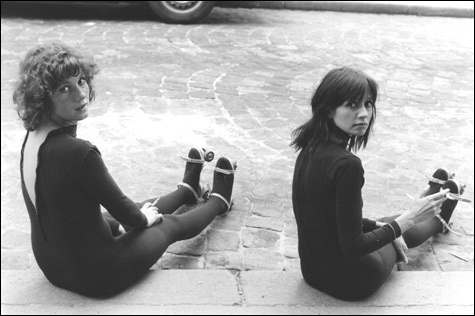
CÉLINE ET JULIE VONT EN BATEAU: The first film in which everything is invented. |
For many backlashing film scholars and canonical cinéastes, most of the big players in the French New Wave — Truffaut, Chabrol, Rohmer, Resnais, etc. — have been, over time, at least a touch overrated, save two: Jean-Luc Godard and Jacques Rivette. Godard’s pioneering, intransigent brilliance has certainly had its glory time on the public radar in the last 45 years, but Rivette? Qui est-ce? In many ways the movement’s phantom outlaw, Rivette, the subject of a major Harvard Film Archive retrospective this month, shares the same acre of history with his much more famous compatriots, but here he’s virtually unknown. Older filmgoers might recall the Anna Karina nunnery saga LA RELIGIEUSE|THE NUN (1966; January 5 at 9:15 pm + January 6 at 6:30 pm), and the next generation will surely remember LA BELLE NOISEUSE (1991; February 2 + 4 at 7 pm), surely the most-seen Rivette movie by simple virtue of Emmanuelle Béart’s buck-naked presence as an artist’s model, occupying hours of screen time. But otherwise he has been an apostate, a voice from a strange and personal territory that has been largely unmarketable to even a ’60s-’70s urban film culture community high on Antonioni, Bergman, and Godard.
It’s not difficult to fathom why — from the beginning, Rivette’s films have occupied a dream-time parallel reality, an inexplicit, vaporous republic chock-a-block with free-associative consciousnesses, unreadable connections, causes without effects, irrational but contagious suspicions, metaphoric ghosts, characters matter-of-factly existing outside the flow of “real” life, searches for unarticulated goals, social orchestrations centered on illusions, and anxieties about unseen phenomena. Which is all to say, Rivette’s movies are movies at their moviest — to understand him as an artist is to grasp his notion of movies as an alternate universe that mirrors our own but that in the mirroring disconnects experience from our complacent knowledge of life. The films are seductions whereby we are lured, by the very cinematic apparatus we trust to tell us clear and enthralling stories, into ideas of authentic otherness, of experiences cleaved from our neurotic beliefs in autonomy and omniscience. In ordinary movies we know everything we need to know, like gods; in Rivette’s œuvre, we’re Beckettian lost ones, repeating questions, wondering what’s underneath everything, waiting for rumored salvations.
In this the filmmaker bumps into the atmospheric figure of David Lynch. We’ll probably never know how much rare Rivette has been consumed over the years by our famously impulsive master of all that is Lynchian, a man who admits to seeing few movies and remembering fewer, but Inland Empire may be the craziest, creepiest all-video film Rivette never made. What’s underneath, indeed — it’s the ultimate question to every story, yet Rivette, a cineastical metaphysician if ever there was one, knows it can never be answered, because we’ll never know for sure. It all began with PARIS NOUS APPARTIENT|PARIS BELONGS TO US (1960; January 5 at 6:30 pm + January 6 at 9 pm), crowding alongside so many other debuts in French cinemas that year. Rivette had actually started his two years prior, before Godard, Truffaut, and Chabrol started theirs, and he took a characteristically methodical year to micro-edit and post-dub the footage. Here was the chilly, existential side of the Wave, a film that numbly tracks the life of a young student (Betty Schneider) as she meets up with Parisian neighbors and an ad hoc theater troupe putting on Pericles; their rehearsals are inexplicably tense, their parties are funereal, and their conversation is dominated by talk of murders and/or suicides, the victims of which we never meet, some of whom might not even be dead, or “exist” at all. Love lives intertwine and drama leaks out like ignitable propane, but mostly the almost two-and-a-half-hour Paris nous appartient is a comatose nightmare in which a deadened sense of paranoia envelops you without anyone saying a single explicit thing to suggest it.
