MONEY: That’s what they want. |
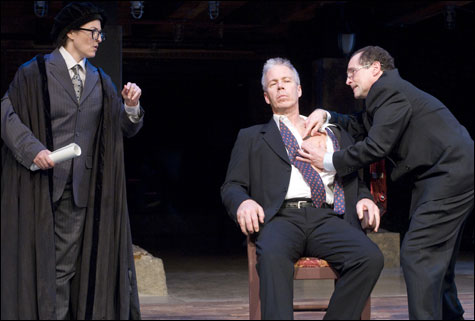
Naming The Merchant of Venice after Antonio is like naming Medea after Jason. The victim isn’t half as compelling as the avenging victim, and such is Shylock, the diamond-hearted center of Shakespeare’s unsettling comedy set on the Rialto — in Actors’ Shakespeare Project’s current rendering (at Midway Studios through December 7) a street as lucre-centric as Rodeo Drive. Coins are jingled and bills peeled away from thick wads of cash from the get-go in a bold, fleet production in which Shylock is not the only man made — or unmade — of money.
Director Melia Bensussen is not the first to suggest that the Christians of Venice are as obsessed with cash as Shylock is. But what Bensussen, an intelligent director who is also a practicing Jew, brings to the table is an unwillingness to take a Sound of Music approach to solving the problem that is Shylock. In her judiciously trimmed modern-dress production, Jeremiah Kissel, also an observant Jew, is a tough if also heartrending Shylock — in the beginning a guy you might meet at a bar mitzvah, later one you might meet in a nightmare. Approached by Antonio and his empty-pocketed chum, Bassanio, for money to finance the latter’s wife-winning mission to Belmont, Kissel’s Shylock is a half-menacing, half-mischievous kibitzer, a fast-talking gum chewer who, every time he mentions the rich sum of 3000 ducats, either takes his head in his hands and shakes it or slaps himself silly. Here the frisky Borscht Belt businessman may hide malevolent intent beneath some pointed clowning, but he’s more likable than Robert Wash’s black-clad, suavely depressive, arrogantly derisive Antonio.
The turning point, of course, is Shylock’s betrayal by his daughter, Jessica, the browbeating of whom Kissel does not stint. But the young lady flees with her Christian lover with not just a casket but also a fat briefcase of booty. Encountering some Christians who have met this tragedy with hilarity, Kissel cuts short his opening riposte at the words, “You knew — ,” thus implicating all Christian Venice in his heartbreak. From this point on, he is agitated but stony, except for a few courtroom flashes mimicking his demonization.
The production separates with uncommon smoothness the play’s courtroom melodrama and its Belmont-set romantic comedy, which is ebullient, particularly when Marianna Bassham’s lively, conspiratorial Nerissa has anything to do with it. The teasing, boudoir-bound comedy of the rings that brings the play to a close, leaving Antonio alone like the cheese, is particularly charming and lusty. Then again, Antonio’s not quite alone. The production’s last image is of Shylock in his counting house, letting hollow coins slip through his fingers.
In 1996, Suzan-Lori Parks wrote a play called Venus, which told the story of Saartjie Baartman, the large-buttocked South African woman exploited in early 19th-century Europe as the Hottentot Venus. Lydia R. Diamond’s new play, being given a credible Boston premiere by Company One (at the BCA through November 22), is entitled Voyeurs de Venus, and therein lies the difference. The subject of this ambitious, provocative entertainment is less Baartman than those who have satisfied their salacious curiosities and lined their pockets by violating her privacy, from the earliest sideshow operators and callous physicians to the present-day audience at Diamond’s play about a woman trying to make hay from the Venus without stepping onto the already trampled field of her dignity.
