'Acting Out' at the ICA, plus Eileen Quinlan
By GREG COOK | April 1, 2009
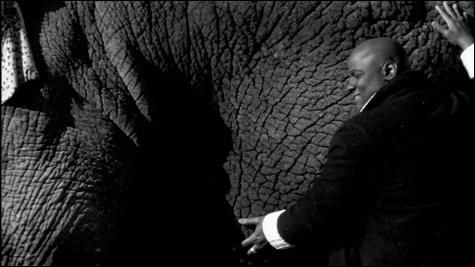
LETTER ON THE BLIND, FOR THE USE OF THOSE WHO SEE If you're going for special effects, you might as well go for the elephant. |
Javier Téllez's 2007 black-and-white film Letter on the Blind, For the Use of Those Who See starts with a catchy premise: he gathered six blind New Yorkers at an empty public pool in Brooklyn to act out the fable of the blind men and the elephant. It was one of the more memorable pieces in last year's Whitney Biennial, and it's the highlight of "Acting Out: Social Experiments in Video" at the Institute of Contemporary Art. It's hard to go | "ACTING OUT: SOCIAL EXPERIMENTS IN VIDEO" | Institute of Contemporary Art, 100 Northern Ave, Boston | through October 18 | "MOMENTUM 13: EILEEN QUINLAN" | Institute of Contemporary Art | through July 12 |
wrong with an elephant.Here ICA curator Jen Mergel collects videos by five artists to frame a trend of artists staging "social experiments" that they hope will yield insights into life and politics and society and what not. These pieces are like arty versions of the manufactured moments and stunt contests of reality TV — and another sign of reality TV's global hegemony. Like American Idol or Survivor or Colonial House, the projects become their own creatures; not about real life exactly, they're documentaries of the behavior of people in contrived situations, a genre that offers its own strange fascinations and insights.
Born in Venezuela and now based on Long Island, Téllez got the idea for his 28-minute film from the old tale where each of a group of blind men feels a different part of an elephant and comes to his own conclusion about what he's touching (leg = pillar, tail = rope, trunk = tree branch, ear = fan, belly = wall). Each man is correct about his fraction of the whole; each is wrong about what it adds up to. The story is told as a lesson of how the truth can be conveyed in different ways, of how we individually glimpse a different slice of a big cosmic reality, of how our different views of the whole can lead to disputes among those who insist that their part is the whole or at least the essential part. As an artwork, "Letter on the Blind" is about the slippery nature of vision, of perception.
Its format is repetitive: shot of blind person, he gets up, he feels elephant, voice-over about elephant, voice-over about being blind, repeat with next participant. "It felt like a tire, a car tire, except it was warm. It wasn't a good feeling." "When I first went to touch it, I bumped into it, and I thought it was the wall. It felt like thick lizard skin." "I felt an ear that felt like a hat and a trunk that felt like a hand." "You feel the ridges and the bumps. And you can feel the life pulsing through it. You can't hide it." "It felt like I was touching some curtains." "I imagined it to be quite large, but I couldn't really sense how wide or tall it was. . . . And then I couldn't tell if the damn thing was breathing or not breathing."
 Related
:
Smoke and mirrors (and elephants) at the ICA, Slideshow: Chunky Move at ICA, Slideshow: Experiment dance night at ICA, More 
- Smoke and mirrors (and elephants) at the ICA
Not into wheatpasting and framed posters? The ICA is about to serve up two shows by artists who promise not to pop up on street walls all over the city.
- Slideshow: Chunky Move at ICA
The Australian troupe Chunky Move performed its 2004 work I Want to Dance Better at Parties at Boston’s Institute of Contemporary Art from March 27 to 29.
- Slideshow: Experiment dance night at ICA
DJs Pase Rock, XXXchange, and Ghostdad spin beats at the ICA's Experiment: Fully Fitted dance night on April 3.
- A cut above
From out of blearily luminous pools of spiraling orange fractals, the disembodied head of a stately-looking man emerged, coaxing us to attention with little more than his calming gaze and an invitation to “a new beginning.”
- States of the art
In New England, where you can't swing a sack of cranberries without hitting a venerable cultural institution, anyone with access to a car (or even a subway pass) can scope out these topnotch art museums.
- Summer people
Ever wonder why there is so much professional-level art made and shown in Maine, a state with a total population less than that of many minor cities? One answer is that following the fame of people like Winslow Homer, creative types flocked to Maine, often to artists' colonies.
- Photos: Shepard Fairey, Z-Trip, Chuck D at the ICA
Shepard Fairey spins at Obey Experiment REDUX at the Institute of Contemporary Art in Boston
- Conflict and convergence
Bill T. Jones/Arnie Zane Company’s Another Evening: Serenade/The Proposition is an elegant layering of dance, design, music, and words.
- Game show
On November 12, the Institute of Contemporary Art opened its biennial Foster Prize exhibit of “Boston-area artists of exceptional promise.”
- Photos: Black Moth Super Rainbow at ICA
Photos of Black Moth Super Rainbow's performance at the ICA
- Topographic musings
"Aggregate" is Maine College of Art's second themed Alumni Biennial at the Institute of Contemporary Art, showing work chosen by a jury from among recent work by BFA and MFA graduates. While the artists represent a range of mediums, graduating class ('97 to '08), and experience, the integrity of the selected works is consistently impressive.
- Less

Topics:
Museum And Gallery
, Entertainment, Artur Zmijewski, Eileen Quinlan, More
, Entertainment, Artur Zmijewski, Eileen Quinlan, Eileen Quinlan, Eileen Quinlan, Yael Bartana, Yael Bartana, Yael Bartana, Johanna Billing, Johanna Billing, Less
