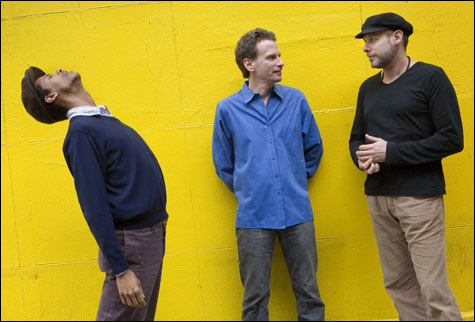
GOING HIGHER: Turner’s Zen serenity distinguishes his recovery from a potentially catastrophic injury as well as his work with Grenadier and Ballard in Fly. |
WFNX Jazz Brunch Top Five
1. Fareed Haque, Flat Planet [Owl Studios]
2. Madeline Peyroux, Bare Bones [Rounder]
3. Dr. Lonnie Smith, Rise Up! [Palmetto]
4. John Scofield, Piety Street [EmArcy]
5. Jake Shimabukuro, Live [Hitchhike Records] |
Let's get the drama out of the way first. In November 2008, cutting firewood at his home in Brooklyn, Mark Turner, 42, arguably the most influential tenor-saxophonist of his generation, lost control of the power saw he was using, and it severed tendons and nerves in the index and middle fingers of his left hand.After surgery, doctors predicted six to eight months of rehab and no clear prognosis of how much use of his fingers Turner would regain. For two months, his fingers were in splints, and by time he could use them at all, the muscles had atrophied. There was slow rehab that included finger exercises every two hours all day long. Then he was allowed brief workouts with his horn — just moving his fingers on the keys for short periods, then playing for an hour or so once every three days. By the end of February, he was performing again, "hungrier and more technically together than I recall," reported critic David Adler in a blog post.

Turner's hand will probably not fully recover. "I'm never going to be able to make a full fist," he told an interviewer for Newark jazz station WBGO-FM. And the loss of flexibility means he's had to learn how to play flat-fingered. Turner is a practicing Buddhist, and he was reported by friends to be typically Zen following the accident. When I reach him in Brooklyn, he talks about his condition with an even affect: "The middle finger moves a little bit, but the index finger is definitely flat-fingered. Which is not optimal for a saxophone player. It's changed my playing, and I've had to learn how to replay certain things. So it's pretty much what it is. I can do it, but I have to learn and change things."
Boston audiences will have a chance to hear Turner's progress — and cheer him on — when he comes to the Regattabar as part of the trio Fly next Friday in support of their ECM debut, Sky & Country. (They also play special "Marsalis Jams" sets with Berklee students at Café 939 on April 15 and 16.) On the new CD you can hear what's made Turner such a sensation among musicians. In the early '90s, he began to depart from the Coltrane sound that dominated jazz tenor sax, opting for the light floating sound of tenor Warne Marsh, altoists Lee Konitz and Paul Desmond, and clarinet and alto player Jimmy Giuffre. It's a sound, wrote New York Times critic Ben Ratliff in a 2002 profile, that is "evenly produced from the bottom to the top of the horn, in long, chromatic strokes."
In Fly, with bassist Larry Grenadier and drummer Jeff Ballard, Turner is at his best. In his complex, multi-part pieces (he wrote four of the album's nine tracks), the distinction between written melody and spontaneous outpouring is blurred; Turner's saxophone lines always sound invented on the spot, but informed with a sure compositional logic. The a cappella intro to his "Ananda Nanda" is unrelated to the theme that follows, but it begins in a high soprano range, works through various scalar patterns, alternating upper and lower registers, a complete composition in itself. Coltrane-style tenorists swoop into the altissimo register for exclamatory effects, but Turner can float up and stay there, spinning line after line.
"Most saxophone teachers will tell you about the overtone series," he says, explaining how those notes — higher than the horn's natural range — are produced. "But the extent that you want to do it is on you." He credits his first teacher, Leo Potts, at Long Beach State and then Joe Viola at Berklee for helping him with overtones. In the meantime, he studied the playing of people like Marsh, Desmond, Konitz, Giuffre, Joe Lovano, and George Garzone.
In part it's the rigorousness of Turner's approach, and his methodology, that's influenced his peers. But it's also the sheer beauty of his sound and conception. In some of Sky & Country's more tumultuous tunes (check his long, serene lines against the drum 'n' bass throb and patter of Ballard and Grenadier on the opening of "Super Sister"), he's like a Lester Young for the digital age. On tunes by Ballard and Grenadier, he plays some soprano sax at their request, but he doesn't see himself using it on his own tunes. "It's not that I don't like it, it's just that I don't hear it on everything. And otherwise, I'd rather deal with another instrument." In the future, he sees himself playing more clarinet. Another reed instrument Lester Young excelled at.
