PORTABLE MAO The condensed stage version of Jung Chang's best-selling memoir delivers pageantry but little in the way of flesh-and-blood characters. |
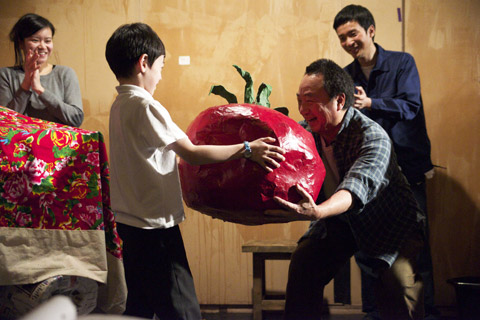
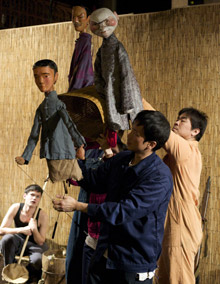
Confucius might have doubted the wisdom of bringing Wild Swans to the stage. Of course, that venerable philosopher was yesteryear's news in the China of Mao Zedong. But Jung Chang's compelling 1991 bestseller, Wild Swans: Three Daughters of China, is a 500-plus-page epic memoir that interweaves personal and political history across a skein of almost a century. To translate such a complex admixture of contemporary events, family tragedy, and coming of age into theater, without being reductive, would be impossible. Nonetheless, there might have been a better whittling than this by playwright Alexandra Wood. A co-production by American Repertory Theater and England's Young Vic and Actors Touring Company, it is in its world premiere at the Loeb Drama Center (through March 11). In Wood's wooden adaptation, which has been in development in England for several years, it isn't just Chairman Mao who speaks in placards.By far the most dynamic thing about the theater piece is its design — which pushes a storm of rhetoric and pageantry along while suggesting a teaming, rapidly changing China. Whereas the book encompasses the lives of Chang's grandmother, her parents, and her siblings, the Wild Swans production team, led by director Sacha Wares, reasonably chooses to focus on the parents, fervently idealistic Communist officials persecuted and disillusioned by the Cultural Revolution of the 1960s and '70s. The siblings do not appear, and the necessarily simplified story of the grandmother — a warlord's concubine who managed to hold on to her daughter — takes the form of an entertainment enacted by rod puppets. The contrast between this quaint art — performed by the actors playing Chang's parents as they try to convert hoeing peasants to Communism in the late 1940s— and influential Chinese artist Wang Gongxin's striking, fragmenting video design for the play's final scenes, set in the '70s, is in itself a comment on cultural transition.
 |
Divided into five "acts" sans intermission, Wild Swans moves from a noisy open market and hand-tilled field to the honking-and-bus-filled streets of modern China. In Miriam Buether's set design, the bamboo-covered walls of the early scenes are peeled away to reveal muted versions of Chinese Communist propaganda posters, with their empowered peasants beaming over cornucopias of produce. The production also fields a large ensemble portraying farmers and laborers, self-criticizing Communist bureaucrats, insistent proselytizers for the Great Leap Forward that led to widespread famine, and the youthful, intimidating Red Guards bent on deifying Mao and purging a previous generation. At the crux of the progression are Chang's earnest if unbending father, condemned for criticizing Mao, and her mother, rendered suspicious by her family background. Katie Leung, best known as Cho Chang in the Harry Potter films, plays the teenage Er-Hong (Chang's name before she changed it to Jung), familially loyal but angling for an escape through education.The acting by the large cast is but serviceable, though the flag-waving Red Guard pageantry is impressive. Gareth Fry's Eastern-influenced sound design and some frenzied patriotic anthems are utilized to rousing effect. And there is one protracted moment, in which Mao's Red Sun presides over a choreographed denunciation of the parents, actress Ka-Ling Cheung's face a mask of contained sorrow, that starts to capture the enormity and spirit of the book. Certainly the whole project is nothing if not worthy and ambitious. But you know early on that, with its speechifying characters and shades of Socialist Realism, this Wild Swans is not going to work. Chang's memoir is a thing of flesh and blood, eyewitness and compassion. The play, however aspiring, is all calligraphy and cardboard. ^
 Related
:
Interview: Katie Leung follows Harry Potter with ART's Wild Swans, Review: Generic Theater takes on Havel's tale of an intellectual amid revolution, I was a teenage Sandinista, More 
- Interview: Katie Leung follows Harry Potter with ART's Wild Swans
Fans of J.K Rowling's wizarding empire (read: every man, woman, and child) all remember the moment we were introduced to Cho Chang, the lucky Ravenclaw who gets to paint the town (and do a bit of snogging) with Mr. Potter himself.
- Review: Generic Theater takes on Havel's tale of an intellectual amid revolution
In these days of ongoing revolution, many are drawn to look back to protest and uprisings of the past.
- I was a teenage Sandinista
As a freshman philosophy major at the University of Colorado, Deb Olin Unferth fell in love with a junior named George. A pious Evangelical, George felt it was his duty to help his Communist brethren in Central America fight against their capitalist oppressors. So he did, and Unferth went with him.
- John Birch Society alive and confused in Maine
The Maine arm of the John Birch Society, founded in 1958 to combat communist influence in government, visited the State House in Augusta last week, calling for legislators to, well, do nothing, as it turns out.
- Mayor's race kicks off
Last week, the first three mayoral candidates filed their paperwork. So begins Portland’s first elected-mayor campaign in more than eight decades.
- Review: SpeakEasy makes the best of Nine
Music had better be the food of love in Nine , because there's little else in the Tony-winning show to indicate why its middle-aged, three-timing protagonist is such a chick magnet.
- Review: 2nd Story's Becky Shaw is engaging
It's fascinating to watch what people put themselves through to insulate themselves from what they put themselves through through other people. Got that?
- Preview: Trinity Rep takes The Crucible to the streets
Arthur Miller's The Crucible was a seminal work of American theater, taking a shameful passage of history — the Salem witch trials of the late 17th century — and melding it in the audience's consciousness with a contemporary parallel — the Red Scare hearings of the House Committee on Un-American Activities, which prompted a Hollywood blacklist of suspects.
- Review: Theater Project's Pride and Prejudice stays authentically powerful
Jane Austen's classic 19th-century novel of manners and morals, Pride and Prejudice , has undergone a truly weird range of reinterpretations. But the classics also deserve a little unalloyed love.
- Found in translation
When Susan Conley, her husband, and their two young boys moved from Maine to Beijing in 2008, she had plans to write about her experience as a mother in that huge, foreign world.
- Review: The Druid’s fine trip to Inishmaan
Although Martin McDonagh’s The Cripple of Inishmaan is the least likely of his plays to provoke a riot, as John Millington Synge’s The Playboy of the Western World did at its 1907 Dublin premiere, it is the most Synge-like of the Anglo-Irish dramatist’s works.
- Less

Topics:
Theater
, Communism, Theater, memoir, More
, Communism, Theater, memoir, Mao, Wild Swans, Less
