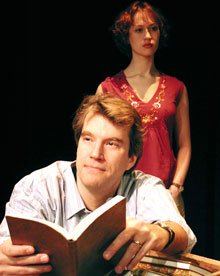
 We remember our diaries as works of art,” says Michael, a writer. “Until we read them.” Then it seems that memory itself might be the real master. For editing life’s tone, style, and coherence, it’s hard to beat a journal’s written remembrance, but remembrance of that remembrance makes the story even better. It also makes tough reading of the earlier version. That’s what married novelists Michael and Linda Waterman (Janet Mitchko and Robin Bloodworth) find when the two read each other’s journals. Truth gets some reworking in the New England premiere of Fiction, by Stephen Dietz, on stage now under the direction of Christopher Schario at The Public Theatre.
When Michael and Linda first meet, at a café in Paris, they exhibit the sort of urgent, exaggerated animosity attributable only to caffeine and early-stage attraction. Their self-conscious mockeries and arguments are a prelude to the banter-filled marriage that follows. And when, twenty years on, Linda is diagnosed with a malignant brain tumor (with a “dreadfully floral” scientific name), it is this connubial moxie that helps them through. The thing that really messes with their narrative, though, is that when Linda instructs him to read her journals when she’s gone, she follows it up with a request to read his before she goes.
“None of us, given a hard look, can fail to disappoint,” rules Michael with dark, writerly gravity, and it proves true as Linda takes us back through the decades of his journals. We might disappoint each other in myriad ways, but Linda's operative disappointment concerns Michael’s dalliance with a nubile young “art tart” at a month-long writers’ retreat. Gamine and red-headed, Abby Drake (Victoria Mack) is the haughty granddaughter of the retreat’s founder, and is clearly fond of playing catalyst with her sinewy wit and bitchery. She’s drawn to Michael, despite his rather impeccable boorishness, on account of the work of his then-more-successful wife, who attended the same retreat some years before. Moving back and forth between the flashback of the journal entries, the upheaval of their discovery, and the narration that each writer offers on the way, we’re taken along a twist-rich story line that asks us to question where truth and fiction converge.
Dietz’s script luxuriates, to great effect, in the self-reflexiveness of two writers dealing with the narrative of their marriage. The comforts and the tensions of their shared vocation are intimate and insular, obsessions and weaknesses that ring not just true but eternal: “A writer is only good at two things” when it comes to other writers, Michael avows with grim humor: “Envy and criticism.” And: “I hate writing,” he admits in his journal, after arriving at the retreat and finding himself blocked. “I like to have written.”
