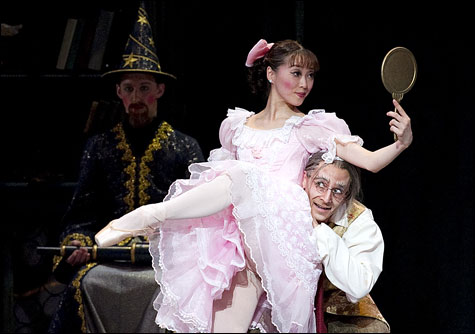
LIVING DOLL: Misa Kuranaga makes Boyko Dossev believe his mechanical creation is now a daughter. |
Set in the usual small village — this one in the Carpathian Mountains of Eastern Europe — Coppélia might look like just another pleasant 19th-century ballet about a boy, a girl, and another girl. But appearances can be deceiving — and that’s the theme of this work, whose title character is a life-size mechanical doll. At the Opera House last weekend, Boston Ballet music director Jonathan McPhee tore into the mazurka of Léo Delibes’s Prélude, as if to make the audience sit up and pay close attention. What followed — in the 1974 version by George Balanchine and Alexandra Danilova — largely rewarded that attention.
Coppélia first saw the light of day in Paris in 1870, with a score by Delibes that would become a model for Tchaikovsky and Stravinsky, and choreography by Arthur Saint-Léon. Like the Olimpia segment of Offenbach’s The Tales of Hoffmann, it’s based on E.T.A. Hoffmann’s dark story “The Sandman,” in which the student Nathanael — with the “aid” of a special spyglass — sees a clockwork doll as a real woman and his fiancée as a clockwork doll. Hoffmann is riffing on the fear that we’re all nothing more than clockwork; Coppélia, on the other hand, is that familiar narrative (think James in La Sylphide, or Albrecht in Giselle, or Siegfried in Swan Lake) of a boy who keeps looking past his girl in the hope of glimpsing the Eternal Feminine.
The plot is ballet-simple. Frantz and Swanilda are sweethearts, so she’s not pleased when she catches him blowing kisses to the doll-beautiful Coppélia, who sits all day reading out on the second-floor balcony of her father’s house. Frantz blunders again when he kills a butterfly he and Swanilda are chasing, and though he tries to appease her, he turns back to Coppélia whenever Swanilda’s out of sight. In the second act, Swanilda and her eight friends, having come upon the key that Dr. Coppélius has dropped, sneak into his house and discover that his workshop is full of dolls — including Coppélia. Coppélius returns and chases them all out, only to find Frantz climbing in through the balcony window. Frantz professes the richness of his love, but when he acknowledges that he’s poor in worldly goods, his prospective father-in-law switches to Plan B, which involves slipping Frantz a mickey and then trying to transfer his vital forces into Coppélia, who, wheeled out from her alcove, now looks — surprise! — just like Swanilda. (Turns out she stayed behind when her friends left.) Coppélius is delighted as his creation gradually comes to life, though she’s not the dutiful daughter he was hoping for. When Swanilda finally manages to wake Frantz, she rubs his nose — and Coppélius’s — in the reality that Coppélia is and will always be just a doll.
