Box sets and jazz history
By JON GARELICK | December 12, 2006

JAMMIN’: Does a new box set make Weather Report relevant again? |
Every year the box sets reshuffle jazz history. At their very least, boxes — with new sequencing, new liner notes, improved sound — can change how we read that history; at their best they can change how we hear it. Mosaic’s new DUKE ELLINGTON: THE COMPLETE 1936-1940 VARIETY, VOCALION AND OKEH SMALL GROUP SESSIONS (seven CDs) finds material that was originally released under the names of various Ellingtonions (Johnny Hodges, Cootie Williams, Rex Stewart) and then re-released in scattered formats on disparate labels throughout the years and gathers it comprehensively under one roof for the first time. These sessions were cranked out for jukeboxes as a way of keeping the market flooded with budget product — the Duke brand, but different. And in its way, it reveals a kind of secret life of the Ellington band.There’s nothing so radical going on in FATS WALLER & HIS RHYTHM: IF YOU GOT TO ASK, YOU AIN’T GOT IT! (Bluebird/Legacy; three CDs). Producer Orrin Keepnews created a more expansive chronological set for RCA/Bluebird in the ’90s — Waller recorded more than 300 sides in his short life (1904–1943). This is the portable Fats: a disc each of his original tunes, covers of Tin Pan Alley, and instrumentals-only. That might not be the best way to hear Waller — since the set isn’t chronological, you might as well load all three discs and hit shuffle. Which is just another way in which the iPod era makes a mockery of the compiler’s craft.
The set — abetted by Dan Morgenstern’s notes and photographs drawn from the Rutgers Institute of Jazz Studies, which he directs — transports us back to an earlier era even as the music punches through with startling immediacy. Here was the jazz musician as comedian/pop star, undercutting sentimental treacle with his winking vocals, trading barbs with the great trombonist Jack Teagarden on “(I’ll Be Glad When You’re Dead) You Rascal You,” flying through his own hits (“Ain’t Misbehavin,’ ” “Honeysuckle Rose”) in his smooth stride or unfurling silken cascades of notes on “Numb Fumblin’ ” — the Harlem Dinu Lipatti. What’s more, with a cohort including guitarist Al Casey and the Armstrong–like phrasing of trumpeter Herman Autrey, Waller created some of the best small-group swing on record.
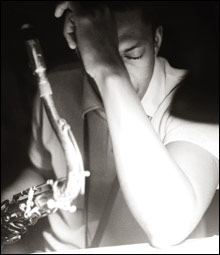
BIG HORN Fearless Leader is “formative” Coltrane, but essential. |
Harvey Pekar helps rewrite some of the history he helped create on STITT’S BITS:THE BEBOP RECORDINGS, 1949-’52 (Prestige; three CDs). In one of the best of Pekar’s old American Splendor comics, he laments the latest batch of records sent to him by Downbeat for review, one that includes Sonny Stitt: “He always makes the same kinda record . . . couple blues, couple standards, couple things based on Rhythm changes.” And yet, who’s providing the liner notes to this three-disc set but Pekar: “Stitt . . . was apparently happy to go into a studio and record standards, blues, and things based on ‘Rhythm’ changes until the cows came home.” (“Rhythm” being the Gershwins’ “I Got Rhythm.”) So maybe Harvey is making up for past slights — he argues that Stitt (1924–1982), “one of the founders of bebop,” deserves his props.And this set is bebop heaven. In later years, Stitt took his knocks as a Charlie Parker clone, and at first you mark every patented Parker lick as it passes by. But soon you’re caught up in Stitt’s originality — his authority on tenor (where you can hear his influence on Coltrane and Sonny Rollins, among others) as well as alto, his daunting speed, but also his soulfulness on ballads. A nine-disc Mosaic set from a few years picked up from where this set leaves off, but here he is as bebop’s first wave was cresting. In the early tracks you can hear the music’s links with swing, in the later its prototypical relation to R&B (sets with Gene Ammons), and the vocal ballads and novelty tunes in between. But this is just informing context for echt bop, especially on choice tracks where Stitt is jamming with Bud Powell, Curly Russell, and Max Roach.
 Related
:
The anxiety of influence, Holy spirit of the saxophone, Listen up, More 
- The anxiety of influence
“I’m playing changes!” That’s what a young jazz-pianist acquaintance of mine announced exultantly to one of his musical buddies back in the early ’70s.
- Holy spirit of the saxophone
John Coltrane died 40 years ago this past July at the age of 40 of liver cancer.
- Listen up
It’s the first year a long time where I truly felt like I didn’t listen to enough music.
- In action
In the era of YouTube, we’re apt to forget that not every note of music ever played has been captured on film or video.
- Sweet reads
Here, listed alphabetically by author, are 10 of the best works of fiction, non-fiction, and poetry the Phoenix wrote about in 2007.
- Seven layers of heaven
Working on the fly, the organizers created an odd layer cake.
- Getting it live
Noah Preminger — bearded, shaggy-haired, 23 years old — plays tenor saxophone like a man at least twice his age while remaining completely of the moment.
- Personal code
The connection between jazz and India is at least as old as John Coltrane’s composition named for that country.
- Mining the past
John Coltrane acid blasts rage through the Mars Volta’s new The Bedlam in Goliath.
- Fathers and son
It must be daunting to have Joshua Redman’s talent.
- The Souljazz Orchestra | Rising Sun
We're living in the middle of a veritable renaissance of "Spiritual Jazz."
- Less

Topics:
Jazz
, Entertainment, Music, DJ Logic, More
, Entertainment, Music, DJ Logic, Jack Teagarden, John Szwed, Paul Chambers, Jazz and Blues, Miles Davis, Duke Ellington, Charlie Parker, Less
