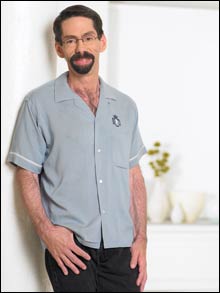
 Twenty years ago, Fred Hersch was known as a talented young jazz pianist and teacher at New England Conservatory. But he was even better known for his unusual status in the jazz world: an openly gay man with HIV. Hersch has worked hard, and in the intervening years he’s established a reputation larger than his illness as one of the jazz world’s top pianists and most accomplished composers. Earlier this month, he made history as the first solo pianist to play a full week at New York’s revered jazz basement the Village Vanguard. When I talked to him on the phone last week (he was in residence at Western Michigan University at Kalamazoo), his health came up only in passing — he’d come down with a sinus infection during the one-week run. “And then I took an antibiotic for the sinus infection that was even worse than the sinus infection. But when I got up to play, I had plenty of energy. The music creates its own energy.”
Hersch brings his solo act to the Regattabar this Friday for two shows in a week rich in solo piano performances — McCoy Tyner will follow him at the R-bar for shows on Saturday and Sunday, and over at MIT on April 1, Ran Blake and Charles Gayle will trade solo sets.
Hersch is a more or less mainstream player; he likes song forms, tonality, fixed — if complex — meters. But on his most recent solo CD, Fred Hersch in Amsterdam: Live at the Bimhuis (Palmetto), you can hear not only the breadth of his technical command but the depth of his poetry. The first tune, the original “The Lark” (for trumpeter Kenny Wheeler), shows him unfolding one of his classic melodic lines in clear song form but also exploiting the instrument, beginning with a staccato repeated note at the very top of the keyboard and then unfolding the melody slowly beneath it. As the improvisation continues, his lines breathe — fleet runs that slow, speed up, turn this way and that, break into rhythmic chording, a questing return to the upper register, some deep bass ruminations. At one point, he sustains fluttering sequences in the left hand while the right explores another melodic idea. Everywhere you hear his talent for narrative development and singing melodic lines that you can feel in your throat. And each piece on the Bimhaus CD has its own character: Monk’s “Evidence” moves into abstraction, Jimmy McHugh’s standard “Don’t Blame Me” glances at the stride of one of his heroes, Earl Hines. On Jimmy Rowles’s “The Peacocks,” he sustains tension — and interest — at a ballad tempo for nearly 12 minutes.
“I think that’s the best track on the record,” he tells me. “For me to get that free for 12 minutes with a ballad that’s a real mood piece. I learned the piece from Jimmy — I have his lead sheet. I knew him in New York in the early years of my career. That’s his most-played tune. It has a real vibe.”
