 |
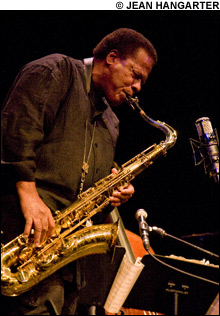
How can a jazz band play no swing rhythms, no grooves -- African, Afro-Latin, or otherwise -- and, really, no songs, and hold 1200 people rapt for an hour and 25 minutes, with virtually no breaks in the music? The Wayne Shorter Quartet is one of a handful of great working bands in jazz right now (the Branford Marsalis Quartet, Brad Mehldau Trio, and Chris Potter’s Underground also come to mind), and they remain so even as they become ever more abstract. At the sold-out Berklee Performance Center on Wednesday night, a handful of tunes floated into view -- “Sanctuary, ” “Zero Gravity,” the thus-far unreleased “Myrrh,” Arthur Penn’s “Smiling Through,” the Irish folk song “She Moved Through the Fair,” “Joy Ryder,” and the encore “Prometheus Unbound” were all on the set list provided by bassist John Patitucci after the show. But these songs emerged merely as fleeting suggestions, way-stations in a sea of constant four-way improvisation. One veteran Wayne watcher said after the show that he thought he heard a bit of “Footprints” and maybe “Infant Eyes.” And who’s to say that he didn’t -- or that the band didn’t play them?The show began with pianist Danilo Pérez playing spare, plinking dissonant chords, Patitucci coming in with fast bass patterns, drummer Brian Blade pattering away bare-handed, then bowed bass and Wayne entering on tenor, Blade moving to mallets, and then the lilting, spare melody of “Sanctuary,” written by Wayne for Miles Davis about 40 years ago, and then some lovely shimmering chords from Pérez as if to announce the tune’s arrival.
There was no standard rhythm and accompaniment. The lyric tension sustained itself throughout the show as a group effort, four independent voices, everyone listening -- different motifs, different rhythmic patterns, different textures, different contrasts providing the thread. This was not the hurtling and heedless Shorter. He played quietly but projected beautifully, intimate and solitary, with a hollowed-out sound on tenor. Pérez provided cues -- refocusing attention with a sudden two-handed chord -- and harmonic backdrops. Blade played colored patterns, simmered to a slow boil, or exploded with bass drum-and-hi-hat barrages. Patitucci alternated bow and pizzicato regularly, and at one point when he and Wayne were playing counterlines, with Blade off in his own rhythm and Pérez holding steady to a spare-chord tempo, I thought, of course, Wayne is thinking orchestrally, each player representing a different section. At times, the band would outline an odd-number barred form together, deferring resolution to a unison climax -- unh, unh, BANG! The previous night, they had celebrated Wayne’s 75th birthday at Carnegie Hall with a string section, so maybe the Berklee show, with just the quartet, offered an opportunity to cut loose even more than usual. But how can music so loose sound so together? Happy birthday, Wayne.
