IT DIDN’T CHANGE YOUR LIFE: It, did, however, make you forget the cold. |
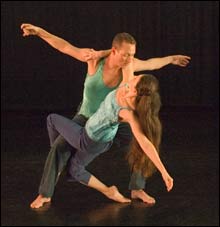
According to Deborah Abel, breath is the key to self-awareness and a defense against the distractions of everyday life. Abel’s The World Is Breathing, which she presented last weekend at MIT’s Kresge Auditorium, folded new and old dances into a meditative ritual. With a musical ensemble directed by Lee Perlman, the 10 dancers established an atmosphere of profound calm that if it didn’t change your life at least made you forget the cold.Abel’s dance is anything but the thrill-packed, angst-driven spectacle that dominates our stages. That, of course, is the point. Influenced by Hindu philosophy and yogic physical practice, the dance flows along, assimilating crisis and celebration as if they were natural features in a landscape. Accompanied by Sanskrit chanting and Indian-influenced instrumentals, three episodes of what you might call life drama are connected by and somehow synthesized into the group’s actions. Struggle, weakness, grief, even love, are subdued and rebalanced against the larger, stressless whole.
Abel’s basic vocabulary consists of a soft swaying, curling, and stretching. The breath impulse behind these simple shifts can take the body into traveling, tumbling, reaching, and lifting. It’s a rhythmic impulse, as breathing is, but each individual generates his or her own breath cycle, so the dancers’ relationship to the music is just approximate. Even in the sections where the group members move in unison, you don’t get the feeling of chorus-line precision.
Individuals periodically gather in communal circles; they ritually identify those who will enact traumatic life experiences. Then they sort themselves into smaller groups, sometimes echoing the phrases of the protagonists, sometimes engaging in playful duets and tasteful orgies.
Abel and Jeffrey Polston are the chosen couple. On a high platform to the side of the space, they dance an intimate but strangely passionless duet (Eye of the Heart, 1996). Bonded together as if they were one shape, they suggest ancient temple carvings. They curve around each other, each supporting the other in slow backbends, somersaults, and embracing lifts.
During a subsequent group dance they’re lifted off the platform. A woman ties Abel’s right hand to Polston’s left with a cloth (The Golden Knot) and they struggle to deal with this hindrance — pulling apart, trying to accommodate each other’s movement, looking for the symbiosis they’d had before. Finally they lock into an erotic pose: she sits in his lap with her legs wrapped around him and they rock gently. After a time three other dancers come and untie the knot.
In The Healing Circle (1996), Wendy Lawson dances with three other women. She starts to falter and they gather around to help her. She seems on the brink of death, and they kneel over her body, gesturing like healers or exorcists to try to revive her. She rises and slowly goes up the steps to the platform, where, perhaps as a spirit, she dances in a bright light while the others conjure over the spot where she’d lain. They lift her off the platform and bring her back to life. With Lawson they do a dance of recovery, joined by the rest of the group for a closing kinship dance.
The entire evening was skillfully put together. The overall calm was jostled by the party scenes, and the flares of ego were quickly quenched. But Abel’s prevailing swing-and-sway movement seemed limited. I thought the young dancers looked as if they could take on more than she had taxed them with.
The World Is Breathing illustrated its peaceful premise almost too well. Maybe a question for all message-driven performance is how well you can illustrate an idea before you become the idea. We’ve all seen those anti-war or anti-crime movies that fetishize violence. Abel’s dance reminded me of classics-to-relax radio. With its consistently mellow dynamics and velvet edges, it hovered between the challenge of attentiveness and the forgetful ease of trance.
