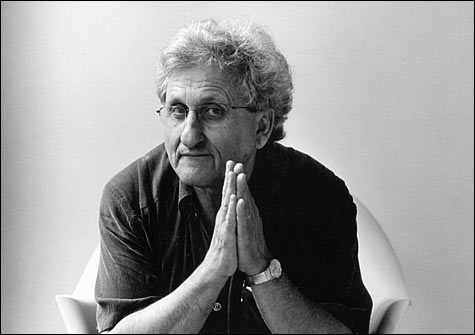
WHAT A DAY!: In shedding his protective shell of anonymity, Yehoshua’s protagonist escapes a bitter Jewish joke. |
Israeli writer A.B. Yehoshua’s A Woman in Jerusalem is an odd, perplexing novel — but also shrewd and profound. The plot is simple enough. A woman killed in a Jerusalem suicide bombing lies unidentified and unclaimed in the city morgue for a week. When a reporter discovers that she was grasping a payroll stub from a local bakery and that none of her co-workers has inquired about her absence, he writes an excoriating article. The bakery’s elderly owner, appalled and fearful that the incident will ruin the reputation of a business that’s been in his family for years, gives his personnel manager the job of finding out who she was and how this happened. The personnel manager is more concerned with refuting the story, with proving that it wasn’t the company’s fault. His aging boss, who’s accepted responsibility, presses him to get on with it. Identifying the victim turns out to be a fairly easy task. But that just begins a never-ending procession of other tasks.
Yehoshua tells the story in a third-person approximation of the weary, exasperated personnel manager, a you-won’t-believe-the-day-I-had voice. It’s a deadpan version of the voice you hear in Jewish humor, the voice that says all suffering, high and low, is the special burden of the Jews. And beneath that voice, implied by the author’s narrative distance, is someone taking in this story of an endless burden and saying, “Stop your kvetching!” Yehoshua is writing about how a war zone (and a country besieged by suicide bombers certainly qualifies) robs the dead of individuality. “The victims” becomes a catch-all category meaning “not us.”

That seems an obvious lesson, but what makes A Woman in Jerusalem fuller, and also slippery, lies in the way that the living here are almost more anonymous than the dead woman. That’s not to say Yehoshua has written indistinct characters. Each one has the sharp edges you encounter in the people you work with or meet. But people wrapped up in getting through the day, people whose outer surface feels both blurred and prickly, can have adopted a form of anonymity. And if getting through the day means not being blown up, that protective shell grows even thicker.
It’s significant that the dead woman is the only character with a name. Everyone else is identified by his or her function. And as the novel goes on, and the personnel manager sheds the resentment he felt at the task, Yehoshua gives you the feeling of a man emerging raw-skinned and alive from a smothering cocoon.
I don’t mean to imply that the book says suffering creates wisdom or that the suicide bombs are some sort of existential — or literal — retribution. (Shortly after beginning the novel, the author lost three friends, a Jewish woman and two Arab waiters, in a café bombing.) Yehoshua is insisting on the bombs as a fact and a violation, not an abstraction or, as apologists would put it, regrettable but understandable. He’s saying that to normalize the bombs by pretending that they’re simply part of the course of things — so as not to disrupt normal life — reduces normal life to a form of derangement.
That’s the view rejected toward the end of the novel by the mother of the dead woman, who in a brief outburst does what no one else has done: she insists on her daughter’s death not as a symbol of the opportunity for atonement but as fact. The personnel manager can’t match her clarity, but his acceptance of responsibility to the dead woman makes it possible, finally, to speak of him as the novel’s hero. His burden has become a calling; he’s escaped the Jewish joke he was caught in.
