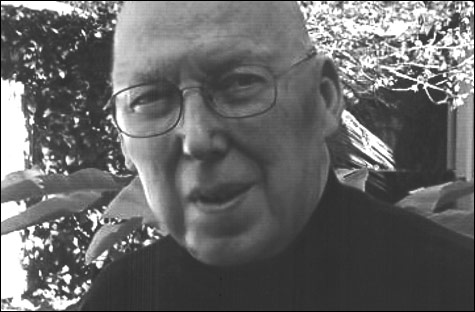
FICTION?: McCarry serves up a society overwhelmed by tin gods, pointless rules, and paranoia. |
The politics of celebrated spy-novel writer (and one-time deep-cover CIA operative) Charles McCarry aren’t simplistic. His books — notably 1974’s The Tears of Autumn, in which he concludes that JFK was assassinated by the Vietnamese in retaliation for Washington’s backing the coup that overthrew Ngo Dinh Diem — credit left and right with equal culpability. But whoever’s to blame, the sin is usually totalitarian excess, which in his latest novel, Christopher’s Ghosts, is exercised by the Nazis in pre-war Berlin. That the attitude, tactics, and profile of the SS and the Hitler Youth so clearly suggest the tenor of the Bush administration may not be the author’s point, but the analogies are frightening.
The Christopher of the title is fictitious American spy Paul Christopher, the central figure in 10 earlier McCarry books dating back to 1973. (Overlook has recently reissued them; Christopher’s Ghosts is a new work.) Throughout his hero’s multi-volume saga, McCarry integrates details of the spy’s personal life with the action. This novel, which could easily be seen as a finale, reverts to Christopher’s early adolescence as an American coming of age in 1939 Germany. If Christopher’s Ghosts ended at the conclusion of part one, it would stand — existential climax notwithstanding — as a brilliant novella of real life and human values confronting Orwellian evil. That the Nazi Party’s intrusiveness — its relentless surveillance of and interference in every aspect of citizens’ lives, its determination to enforce a manufactured hierarchy of racial purities, its thought-control justice system and brutal, lawless enforcement — is based in fact allows the novel to transcend all speculative cliché. Readers are offered a chillingly credible picture of a society overwhelmed by tin gods, pointless rules, and paranoia, a world where the expected meritocracy is turned on its head and anyone with a uniform can give life-or-death orders.

McCarry’s ominous depiction of the times and his engrossing portrait of Christopher’s first, and ill-fated, love affair is so artfully written that you’d believe it was autobiographical. (It’s not.) The book’s second half fast-forwards to the Cold War, which finds Christopher a veteran CIA operative on the trail of one of his ghosts. Straying far off the CIA reservation (McCarry cloaks that agency under the nickname “the Outfit”), Christopher is out to settle a personal score with an escaped SS monster who’s now in league with the KGB. This half of the chronicle wants the heartbreaking grace of the background chapters. Very likely that’s intentional. McCarry’s delivery here pales only by comparison (owing mostly to the relatively truncated narrative), and it suits the perspective of an older Christopher’s wearily jaded outlook. And if the CIA’s methods remind you of SS tactics, Christopher himself doesn’t seem to notice.
McCarry’s craft proves to be as effective as it is subtle. Even as you miss the scumble of innocence that made Christopher’s boyhood story so enthralling and so affectingly dreadful, you’re sucked into a morally ambivalent confession of his later-life emotional odyssey. So skilled is the telling that you’re almost unaware of the degenerating tonal change as it carries you along to the point where you share the unexpected emptiness of the book’s long-awaited climax — even as you’re surprised by its suddenness. Is there such a thing as anti-climactic clout?
Christopher’s Ghosts is a model of great fiction writing. Genre aside, it’s no cheap thriller. McCarry’s yarn is thorough and nuanced — psychological without self-indulgence, political in a very humanist way, emotionally unforgettable.
