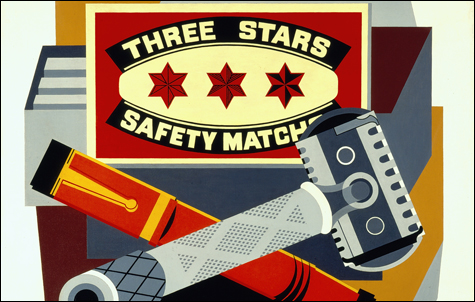
Art © Estate of Honoria Murphy Donnelly/Licensed by VAGA, New York, NY |
Sara and Gerald Murphy are back, and in the words of their friend Cole Porter, “What a swell party it is.” They are as attractive and fascinating as they were in Calvin Tomkins’s New Yorker profile, which was published in 1971 as the book Living Well Is the Best Revenge. Deborah Rothschild has curated a superb exhibition, “Making It New: The Art and Style of Sara and Gerald Murphy,” at the Williams College Museum of Art that is lavish and rich in detail. It has many levels, but the paramount reason for going to Williamstown is that all seven of Gerald Murphy’s extant paintings are on view. You will see for yourself that Murphy is a major artist, America’s foremost Cubist painter.
It’s rare that an exhibition has at its core as much loss and heartbreak as “Making It New” does, and rarer still that a mystery unfolds. As for the world of the Murphys, last names are enough — their friends in Paris and Cap d’Antibes in the 1920s included Picasso, Léger, Stravinsky, Cocteau, Hemingway, Dos Passos, and Fitzgerald. Man Ray took many of the Murphy family photographs that are on display, and the record of their grace, style, and gift for friendship is abundant. This is an exhibition that requires the time it takes to read letters, notebooks, diaries, the helpful wall texts, and the excellent catalogue.

The Murphys were glamorous — Sara was a celebrated beauty — and smart in all senses of the word, interested in music, dance, painting, sailing . . . well, everything worthy of interest, and they didn’t have to work at it. They were natural aristocrats devoted to each other and to their three children. Loss and heartbreak stunned them and contributed to Gerald’s giving up painting, but in the 1920s he painted brilliantly, and the family dazzled like the sun.
Murphy saw his first Cubist work in Paris and knew at once that he wanted to paint. Of the paintings he produced, only seven have survived. His personal favorite, Wasp and Pear (1929), has long hung in New York’s Museum of Modern Art. Like all of his pictures, it is heraldic, public art from an imagination concentrated on things for their own sake and painted without a visible brushstroke. His work is powerful in reproduction, so that photographs of lost paintings give us a sense of what we are missing. When Murphy painted these pictures, they were modern. Now they appear timeless.
What caused his life as an artist and the Murphys’ golden time in France to end? Both of their boys fell ill and died — one from tuberculosis, the other from meningitis. And with the onset of the Great Depression, Gerald’s family firm, Manhattan’s Mark Cross, needed him. In the wake of all this turmoil, Gerald abandoned his art — he did not paint for the last half of his life. How did he cope? That is the mystery. He may have known how to live without making art because he had learned how not to act on his homosexual yearnings. (Kenneth E. Silver discusses this in his catalogue essay.) He made notes for paintings in 1936, but these came to nothing. His son-in-law once went looking for a rake in the family garage and discovered one of Murphy’s paintings. What he might have painted haunts this magnificent, engrossing exhibition.
“Making It New: The Art and Style of Sara and Gerald Murphy” | Williams College Museum of Art, 15 Lawrence Hall Drive, Williamstown | Through November 11 | 413.597.2429
On the Web
Williams College Museum of Art: www.wcma.org
