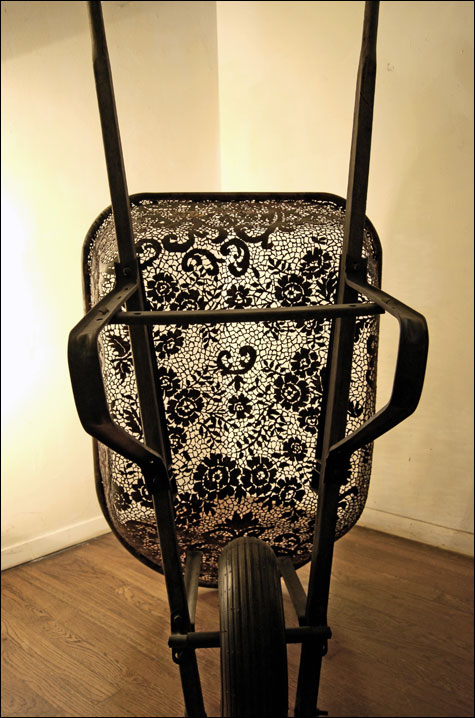
WHEELBARROW: Lane’s content is iffy, but her design and craftsmanship dazzle. |
“Cal Lane: Sweet Crude” | Judi Rotenberg Gallery, 130 Newbury St, Boston | Through July 6
“Harriet Casdin-Silver: Self Portraits” | Gallery Naga, 67 Newbury St, Boston | Through July 11 |
Beauty is back.Twentieth-century Modernism’s main line wound up in a final march toward Minimalist and Conceptualist asceticism. But by the 1990s, the art world was buzzing with talk of a return to beauty. It was mainly a reserved Minimalist beauty — think Félix González-Torres. But now we’ve got lush, bubbly, decorative, rapturous beauty.You can see it in Ranjani Shettar’s bubbly hoops dangling from the Institute of Contemporary Art’s ceiling. Or in Mary O’Malley’s drawn fantasias of birds and flowers and cascading dots that look something like jellyfish. Or in the work of Boston graffiti artist Pixnit, whose stenciled spraypainted mural of a chaise longue, birdcages, and chandelier was on view at Judi Rotenberg Gallery last month. Or in Cal Lane’s current show at the Rotenberg, which gets its oomph from one majorly neat trick: she uses a blowtorch-like-thing to slice I-beams and oil drums and shovels into lacy designs. The upstate New Yorker has called them “industrial doilies.” It’s beauty for beauty’s sake.
A few trends are braided into Lane’s art. Most prominent is feminism, beginning with echoes of 1970s feminist Pattern and Decoration art, which challenged macho æsthetics by embracing floral, decorative, domestic (i.e., “feminine”) designs. This idea continues to play out in third-wave feminist art’s embrace of the girly and its confidence that anything a guy can do a gal can do as well — or better. In Lane’s art, there’s a tension between “feminine” lacy patterns and “masculine” metal welding.
This reconsideration of gender roles is also apparent in the enthusiastic hipster (gal and guy) embrace of traditional lady crafts, as Stitch ’n’ Bitch and Etsy attest. Crafts are a way for people to assert their humanity. It’s a thrill — as I pointed out last week in my review of the “Keepers of Tradition” show at the National Heritage Museum — to see what people can produce with their hands.
That how-did-they-do-that magic is what really grabs me in Lane’s wheelbarrow. It stands on end, its black and rusty-brown metal body perforated with an intricate lacy floral pattern. It looks so delicate that it should crumple. But it defies logic and holds its shape.
There are pieces into which Lane has injected more-explicit content. She slices open oil drums and presses them flat — the body a horizontal panel, with the round ends placed above and below. Untitled American Map (2008) depicts a map of the United States surrounded by curious images: a woman with a chicken, houses, people, a couple kissing, ladies and bunnies, a car, a puppy, a chair.
