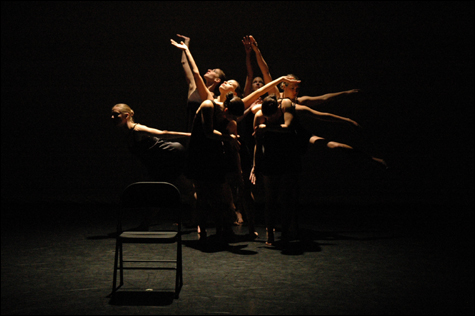
AFFIRMATION: Adrienne Hawkins’s Whoa-Man 360 recalled Alvin Ailey’s character studies.
Photo by Liza Voll.
|
Martha Graham’s Steps in the Street doesn’t look anything like a dance of the 21st century, but at the end of Boston Conservatory’s fall program last weekend it fit right in. The audience cheered wildly for the seven-minute dance that begins in silence, then explodes in a tremendous feat of jumping for 10 women who exit with their energy still unspent, as one outsider strides in the opposite direction. The redoubtable Yuriko, a Martha Graham dancer in the 1940s and now a principal reconstructor of the early Graham works, came to Boston with her daughter Susan Kikuchi to stage the dance.Together with the choreographer, Yuriko brought Steps in the Street back from oblivion in 1989, just two years before Graham’s death. It must not be accidental that the Conservatory’s program left out the date of the original choreography (1936). Three-quarters of a century renders a dance practically an antique, and I guess the producers wanted to stress this dance’s modernity — its minimalistic repetition and relentless physicality. From its first performances by the Graham company in New York, the revival has wowed audiences, but its connection to history is a bit cloudy.

A contemporary film by Julien Bryan served as the basis for the 1989 revival, but the film was silent and couldn’t encompass the full-stage choreography, which had to be re-imagined by Graham and Yuriko. No one could find the original music, by the American composer Wallingford Riegger, so another Riegger score was applied. This was Riegger’s 1940 orchestration of the two-piano score he’d written in 1935 for the Variations and Conclusion to New Dance, by Martha Graham’s pioneering contemporary Doris Humphrey. To Riegger’s polyrhthyms, Humphrey created a stirring and original dance for a group with soloists in counterpoint. Now orchestrated for flamboyant brasses, percussion, and strings, the infectious rhythms have subsided, and the dancers pound away on an underlying regular beat.
The Boston Conservatory dancers Thursday night performed Steps in the Street with clenched determination, loud exhalations of breath, and a thudding heaviness. I don’t know why they aren’t able to relate in their own terms to the themes of the dance, “Devastation — Homelessness — Exile,” or why they don’t simply do the work of the dance, without having to telegraph that they’re working at it. Their long black dresses and black head-wraps, and Linda O’Brien’s moody lighting, gave the whole thing an air of grim desolation. Steps in the Street was one of many modern dances to come out of the depths of the Depression, and all the vestiges of the period that I’ve seen speak of survival, resoluteness, even hope — not at all the downbeat qualities the Conservatory dancers drew from Graham’s jumping dance.
The other pieces on last week’s program were by two local choreographers and a Conservatory graduate. All of them featured an ensemble of dancers sorted out in different arrangements, doing lots of moves to post-minimalist music. There were differences, slight ones, between them, but until Steps in the Street, with its extremely formal floor patterns and detectible if not literal throughline, we could have been watching an evening’s demonstration of all the elegant things student dancers can do.
