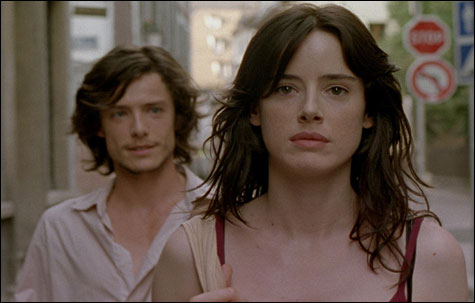
EN LA CIUDAD DE SYLVIA: Unstable and deceptive narratives from José Luis Guerín. |
| “José Luis Guerín en Construcción” | Harvard Film Archive: February 9-11 |
With José Luis Guerín, the cinema returns to its origin in photography, and the questions the filmmaker poses about his art return to the fundamental relationship between the image and the world. In Guerín’s magnificent films, which will screen this weekend at the Harvard Film Archive, everything — narrative, composition, montage — exists between two boundaries. On one side, there’s an experience that has metamorphosed into myth, so that it’s impossible to be sure it ever actually happened. On the other, there’s the place where the experience (may have) happened, as it will look after those who lived it have passed through and left.These two limits are the conditions for Guerín’s cinema, which, caught between them, shuttles like the pages of a sketchbook blown back and forth by the wind — the subject of a fabulous image in the director’s 2007 triumph En la ciudad de Sylvia|In the City of Sylvia (February 9 at 7 pm). Such conditions question not only the idea of narrative and the border between fiction and documentary (a border that each of Guerín’s films crosses endlessly) but also the nature of cinematic time, which Guerín proves to be reversible and infinite, defeating any notional progress or goal — as in the masterpiece En construcción|Work in Progress (2001; February 10 at 7 pm), which surveys a housing project in a sector of the filmmaker’s native Barcelona.

The people Guerín photographs become heroic, even though they remain unknowable in their motives, histories, and destinies. An homage to a vanished amateur filmmaker from Normandy, Tren de sombras|Train of Shadows (1997; February 11 at 7 pm) is a glorious and decayed moving-picture book of portraits twice removed — first by being reconstructed, then by being subjected again to the ravages of time. The dazzling images of Tren de sombras conjure not only hypothetical inner narratives of a departed family’s existence but a whole mini-history of French cinema, from Lumière’s L’arroseur arrosé to Renoir’s Une partie de campagne to Bresson’s Mouchette.
En la ciudad de Sylvia appears to tell the story of a young man who visits Strasbourg hoping to meet a woman he remains enthralled with after a single encounter long ago. This unstable and deceptive narrative is just one of the patterns that the film imposes on reality. Early in the film, a long outdoor-café scene becomes a fascinating adventure in different ways of looking at strangers, without overt dramatic motifs but filled with surprise and suspense, as perspectives shift and rearrange and micro-narratives crystallize and are snapped off.
The companion film, Unas fotos en la ciudad de Sylvia|Some Photos in the City of Sylvia (2007; showing with En la ciudad de Sylvia), purports to consist of “notes for a possible documentary” (which Guerín did not make). Through black-and-white still photos, the film outlines and, in some ways, carries farther the urban cartography of En la ciudad de Sylvia, as figures and faces vanish into cityscapes in an ecstatic montage of overlapping, shifting patterns, and Guerín once again reinvents the cinema, this time as a combination of Dante, fashion ads, a Coca-Cola cup, and the scene in Citizen Kane where Everett Sloane talks about the girl he once saw on a ferry going in the other direction.
