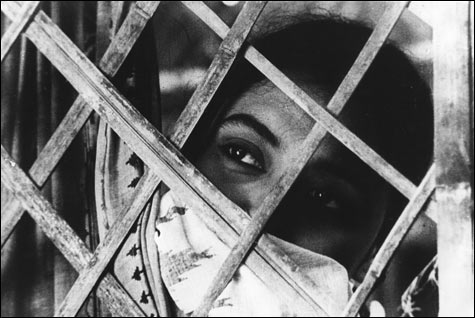
The Cloud-Capped Star |
Separation is the myth and the reality of Ritwik Ghatak’s cinema. His work screams it, shouts it, sings it in image and sound. It’s not enough for a marriage to come to an end; that end also has to become an abstract principle: “Separation is essential,” says the hero’s wife near the beginning of REASON, DEBATE AND A STORY (1974). In E-FLAT (1961), a theater director tells an actress, “Think it is 1947 and you have to leave your home,” at which she breaks down in tears.
The subtitle of the Harvard Film Archive’s five-film retrospective — “The Partition Cinema of Ritwik Ghatak” — alludes to that same 1947 event: the forced migration of millions of Bengalis upon the division of the region between India and Pakistan. Born and raised in East Bengal in 1925, Ghatak became part of that migration, relocating in Calcutta. A leading figure in the leftist Indian People’s Theater Association, he turned to cinema, directing eight feature films from 1952 to 1974. He died in Calcutta in 1976.

Ghatak’s images themselves are partitioned: shots show people and groups in separate areas — the porch of a house, a street — so as to make apparent the social chaos of which their encounter is a sign. Characters stare away from one another — a habit of the self-sacrificing heroine of THE CLOUD-CAPPED STAR (1960) — and gaze out of the frame in different directions. Ghatak’s shooting patterns are seesaw-like: high and low angles, intercut together, turn meetings between people into cosmic clashes; rack focusing pins down figures in discrete parts of the frame. Ghatak’s much-noted work with music and sound effects, which for him are interchangeable (at a Ghatak climax, no domestic or public space can avoid being invaded by industrial clatter, thunderous reverb, heavy breathing, or the sounds of an unseen traffic accident), magnifies the psychological pressures on characters in crisis or heightens a melodramatic revelation.
This internal partitioning of image and sound, though it strengthens Ghatak’s constant theme of separation, has another function. His multilayered, segmented shots pull together characters who are breaking apart — just as his stories seek against reason to deny the separations that are the characters’ constant theme. The heroine of A RIVER CALLED TITASH (1973) keeps threatening to leave her hypocritical, overbearing mother but never does. Over and over throughout Ghatak’s work, expressive and insistent pans link and relink characters with one another and with their surroundings (such as a river or a horizon), as if the camera, in defiance of all the disruptive forces unleashed over the course of a film, were trying to affirm an underlying unity.
In The Cloud-Capped Star and THE GOLDEN LINE (also known as Subarnarekha; 1962), Ghatak draws on Brecht (whose The Life of Galileo and The Caucasian Chalk Circle he translated into Bengali) and melodrama to create a new national cinema, highlighting the trauma of the Bengali diaspora and the dilemmas of an independent India. The former film concerns the decline of a family who end up being sustained by (i.e., exploiting) their oldest daughter, who gives up her chances at higher education and love in order to work. In one of the great Brechtian moments in cinema, the near-demented father, on learning that his son has been injured in a factory accident, declaims, “This was expected; this is the rule.” The Golden Line is a lacerating epic about the fortunes of three Bengali refugees: a man, his younger sister, and the lower-caste boy they adopt. If the images deal in distance and discontinuity (as when the characters visit an abandoned British airstrip), the sounds are too close (especially in the scenes of disaster that accumulate in the last third of the film), creating a uniquely Ghatakian sensory overload.
The Cloud-Capped Star and The Golden Line are ambitious allegories that are improved, not weakened, by Ghatak’s enthusiasm for disruption (the sequence of the older brother’s drunken night out in Calcutta is far more transgressive than the equivalent sequence in Kurosawa’s Ikiru), his will to make anti-masterpieces. But my favorite Ghatak films are two works that, though no less grandiose, are more intimate and even more jagged. In E-Flat, the struggles of a radical theater company become occasions for Ghatak’s most heroic, vibrant images; these swirl with movement, contrast, and energy, doing justice to the heroine’s sense that without extreme emotion nothing beautiful can be created. The camera angles, rather than aspiring to be definitive, are expressive in their documentary-like imperfectness. Even at its most elegant, E-Flat is rough and in-process, like all Ghatak’s work: though each of his films includes at least interludes that convey a deep feeling for landscape and nature, his characteristic visual style is less lyrical than paroxystic.
