O HOMEM QUE COPIAVA One thing leads to another . . . |
| “Jorge Furtado’s Porto Alegre” | Harvard Film Archive: March 7-9 |
Playful and eclectic though he may be, Brazilian filmmaker Jorge Furtado, whose work gets a rare screening in a brief retrospective this weekend at the Harvard Film Archive, has pursued the same preoccupations through his entire 25-year career, beginning with his arch, masterfully constructed and jolting shorts. There’s the conflict between social appearances and realities in “Temporal|The Storm” (1984), a farcical nine-minute effort in which respectable adults hold a meeting of their apocalyptic secret society while their masked teenage children stage a carnivalesque orgy in the basement. Or the brutal logic of the capitalist system that’s explored with disingenuous levity and man-from-Mars detachment in “Ilha das flores|Island of Flowers” (1989). This is Furtado at his archly whimsical best, using documentary footage, an absurdly earnest voiceover narrator, and Terry Gilliam–esque animation to trace the house-that-Jack-built food chain of consumer society from a tomato farmer to the paupers (“mammals with a large cerebellum and opposable thumbs but without money or owners”) who eat the rotten end product (“found unsuitable for pigs”) at the ironically named garbage dump of the title.Inevitably, Furtado’s pursuit of the ironic, devastating truth behind the platitudes and the rituals that sustain us takes on the parallel mirror artifice of the filmmaking process itself. In “O sanduiche|The Sandwich” (2000), a couple seem in the process of breaking up. But no, they’re actually rehearsing a play. But no . . . and so on until your head spins.

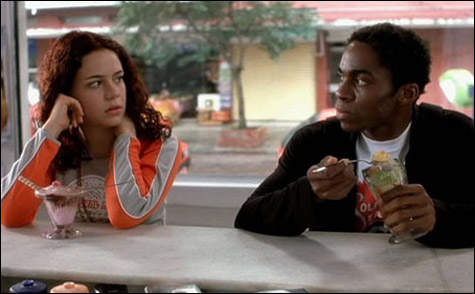
In one of his few feature-length films, these themes of artifice, reality, and subversion combine into a story about counterfeiting. André (Lázaro Ramos), the 19-year-old hero of O homem que copiava|The Man Who Copied (2003), works as a “photocopier operator,” but his real vocation is drawing cartoons. (They provide poignant illustration to his wall-to-wall voiceover narration.) He falls for Sílvia (Leandra Leal), a clerk in a clothing store who lives in the apartment building next door. He’s been spying on her for some time, so add a Rear Window–like voyeurism (by way of Krzysztof Kieslowski’s A Short Film About Love) to Furtado’s bag of motifs.
How can André insinuate himself into Sílvia’s life without coming off as a creep or revealing that he’s a penniless dreamer living with his mother? He decides to turn the capitalist system to his advantage and meet Sílvia under the pretense of buying a birthday present for his mom. Of course, he commits himself to spending more money than he can afford. Solution? Forging banknotes after hours at the copy shop where he works. But the stakes keep getting higher, and soon André is passing notes to buy a gun and is plotting an armored-car heist.
The stakes rise for Furtado, too, and his film gets more complexly — and conventionally — plotted as it goes on. Even so, abetted by his vivid and endearing characters, his knack for subversion prevails. The more he copies genre expectations, the more he breaks the mold.
 Related
:
Topics:
Features
, Entertainment
, Movies
, Short Films
, More  , Entertainment
, Movies
, Short Films
, Lazaro Ramos
, Terry Gilliam
, Krzysztof Kieslowski
, Less
, Entertainment
, Movies
, Short Films
, Lazaro Ramos
, Terry Gilliam
, Krzysztof Kieslowski
, Less 
