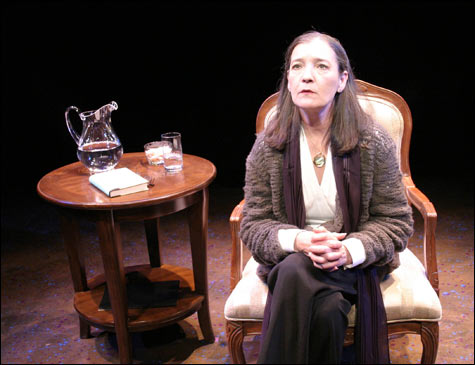
THE YEAR OF MAGICAL THINKING: Nancy Carroll trusts to the magic of Didion's thinking |
"This happened on December 30, 2003. That may seem a while ago, but it won't when it happens to you. And it will happen to you." That's how the character of Joan Didion begins in The Year of Magical Thinking (at the Lyric Stage Company of Boston through January 31), the one-woman show adapted by Didion from the National Book Award–winning 2005 memoir sprung from the sudden death at the dinner table of her husband, writer John Gregory Dunne. It's not the way Didion's book begins, with some "cool customer" (as a social worker dubbed the author the night of Dunne's death) of a Cassandra predicting unpredictable doom for us all. But it does introduce an act of bearing self-reflexive witness — to a universal, almost unbearable, yet oddly calculable experience with which the famously exacting author grapples by means of linguistic precision and the disordered, superstitious thinking of the title.
Some have castigated the theater piece — which played on Broadway last year in a production directed by David Hare and starring Vanessa Redgrave — for not having the same arc as the book. But for my money, the play balances a scalpel-worthy dissection of grief with a cautionary tale about the illusoriness of control. And in the Boston premiere under the near-still baton of Eric C. Engel, two-time Elliot Norton Award winner Nancy E. Carroll, armed with little more than a regal scarf and a formal chair, elegantly stirs Didion's mixture of anguished disorientation and wry, journalistic concision. This is not an easy theater piece, but it is both steely and profound.

Carroll, as Didion, enters the largely bare parlor of a playing space toting her book — a sharply reported account of the year following Dunne's fatal heart attack, during which the widowed literary luminary alternated ruthless management of both her own fact-gathering behavior and the mysterious, coincident illness of the pair's only child, Quintana, with the secretive, irrational bargaining she calls magical or "if" thinking. For example, if she holds on to Dunne's shoes rather than disposes of them, he will be able to use them when he "comes back." After all, she observes upon viewing the corpse, "He does not look as if he needs to be dead."
The 90-minute theater piece differs from the memoir in ways other than its relative slimness. It's more of a linear journey. Apart from a recurrent echo of the mediæval Sir Gawain, there is less literary reference. There is less flashback to the shared life that preceded Dunne's death. And since Quintana, who had already knocked twice at death's door, fell ill a third time and succumbed just months before the publication of the book, Didion's double loss becomes the focus of the theater piece. The character doesn't just realize that we cannot control our fates and that "no eye is on the sparrow." She also comes to wonder whether the reassurance, the myth of safety, that we offer our children is a lie tantamount to other, more mystical forms of magical thinking.
Carroll, seldom rising from her chair, her hands splayed on her knees in a manner both helpless and relaxed, renders Didion's intelligent, elegiac cogitation with the toughness, occasional shrewd humor, and even more occasional tremulousness for which it cries. She may be sharp-eyed eagle to the diminutive Didion's sparrow, but the point is less to impersonate a literary light than to portray the writer's considerable power of self-observation and to trace her journey. Engel, for his part, realizes that this relentless, riveting material needs no fuss. You just need to trust the magic of the thinking.
Applying biography to Spalding Gray would be like carrying coals to Newcastle. The New England–bred monologuist, who plunged to his death from the Staten Island Ferry five years ago this week, mined the mental terrain of his neurotic and peripatetic existence in a series of theater pieces ranging over the course of 20 years, from Sex and Death to the Age 14 to Swimming to Cambodia, Gray's Anatomy, and Morning, Noon and Night. So Louisiana State University professor William W. Demastes doesn't go that route in Spalding Gray's America (Limelight Editions, $19.95, 227 pages). Neither does he do much talking to the folks who knew the lumberjack-shirted storyteller other than across his little table festooned with its glass of water. The book boasts a personal foreword by Richard Schechner, guru/leader of the Performance Group, which morphed into the Wooster Group, where Gray first dipped his toes into artistic autobiography. But by and large, this first tome to weigh in on the unique theater artist does not so much chronicle Gray's already-picked-apart life as put the monologues on the couch — the natural habitat, some might say, of the self-reflexive performer himself.
