The HFA’s ‘Unseen Noir’ unveils America’s post-war gloom
By MICHAEL ATKINSON | May 19, 2008
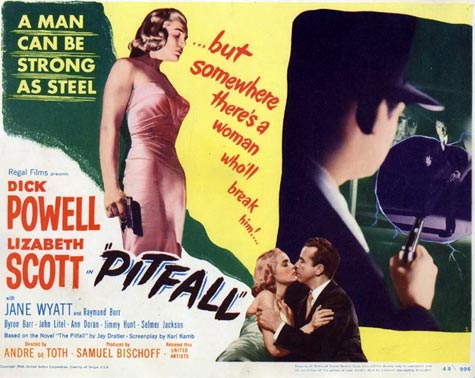
PITFALL André de Toth’s film teems with electric dialogue and potent real-life details. |
| “Unseen Noir” | Harvard Film Archive: May 23-26 |
Welcome to the dark territories again, the republic of bitterness and bile known as noir, as we square our jaws against an amoral universe and roam the rain-wet, lightless American City as if it were a Circle of the Inferno, where backstabbers, goldbrickers, and unfortunates march in closed patterns and puzzle over their fate. What can noir mean to us now? It’s not quite as easy to moon over the existential remarkability of the genre as it once was, when critics like Raymond Durgnat and Paul Schrader were busy specimen-boxing it as if it were a breed of black butterfly that had lived on our streets long ago and yet escaped our notice. Nowadays we’re somewhere near post-retro-neo-meta-noir; the original tropes (visual, gestural, thematic) are no longer recyclable even as TV commercials, and the Jim Thompson–rediscovery school is garnering yawns on the straight-to-video indie shelf. Sin City — please.But the beauty of noir has always been its cultural specificity — the genre is bound wrist and ankle to the unexpected, untamable social malaise that arose during WW2 and exploded in the post-war era. The films are modern anthropology, as wickedly expressive of its context and anxious historical moment as Goya’s aquatints or Faulkner’s novels or Walker Evans’s photographs — but emanating from a kind of American-pulp unconscious, not from the conscientious perspective of a single artist. Suspicion and dread were in the air. As such, the original noirs are timelessly pertinent, and they remain the most resonant school of movie to have emerged in America. Consider that a half-century or more after the fact, the then-disregarded classics of the genre sit high on our trophy shelves and our archival-DVD rosters while the huge, big-budget hits of the ’45-’60 period — think Forever Amber (1947), Jolson Sings Again (1949), The Greatest Show on Earth (1952), The Robe (1953), White Christmas (1954), Guys and Dolls (1956), Around the World in 80 Days (1957), etc. — are forgotten like the blundering, uninsightful junk they were. Against the odds, film noir just does not get old.

The “Unseen Noir” series — five double bills — screening at the Harvard Film Archive this weekend offers up lesser-known films that, though they may not be exactly unseen, are rarely remembered and discussed among noiristes. And none of them is available on video. It doesn’t matter: no individual noir is as important or telling as the genre’s DNA. Jacques Tourneur’s NIGHTFALL (1957; May 24 at 7 pm, with My Name Is Julia Ross) is a terrific, raw example — shot fast on cheap sets with the punchy jitters of a punk record, and focusing on a swollen, shamefaced Aldo Ray as a proverbial man on the run, with a bloody backstory that’s teased out of him by straight-shooting insurance investigator James Gregory (a fabulous and unsung character beacon of the post-war years, his noir roles leading up to his spectacular turns in Beneath the Planet of the Apes and Barney Miller), and hyper-wary alone-in-a-bar hottie Anne Bancroft. “Guys have probably been swarming around you ever since your second teeth came through,” Ray rasps at her (probably a line straight from the David Goodis novel), but soon enough the thugs come out of the shadows, and that leads to, among other extreme thoughts, a torture scenario using the inexorable machinery of an oil-field rig. You can imagine, for all its harried cheapness, why the movie’s been neglected (at least by comparison with Tourneur’s Out of the Past), but the relentless state of bottled-up anxiety insists that you contemplate the dark heart of the ’50s all over again.
 Related
:
Witness to moviemaking, Straight outta Kafka, In all languages, More 
- Witness to moviemaking
The Brattle’s “Rare Film Noir” festival spotlights what makes the experience of going to movie revivals irreplaceable.
- Straight outta Kafka
We want to get into the shower and not emerge until November 2008.
- In all languages
For the past half decade or so, saxophonist Chris Potter has alternately traveled with two of the best bandleaders in jazz, Dave Holland and Dave Douglas.
- La Tourneuse de Pages|The Page Turner
A girl needn’t go to the trouble of losing her leg and replacing it with an assault rifle, à la Grindhouse , to get even.
- William Friedkin at the Harvard Film Archive
However we may still praise, and therefore bury, the American New Wave, we do still run the genuine risk of slipping down the wormhole slicked by present-moment techno obsessions and amnesiac entertainment-media narcissism.
- Splendor on the screen
The arc of Elia Kazan's professional life has its origins in the Group Theatre, where he was trained as an actor and performed in the original 1930s productions of Clifford Odets's Waiting for Lefty and Golden Boy .
- Mix and match
They were a study in contrasts — in personal styles, in modes of masculinity, in American musical-comedy legacies.
- Less

Topics:
Features
, Health and Fitness, Crime, Mental Health, More
, Health and Fitness, Crime, Mental Health, Grand Larceny, Psychotic Disorders, Dalton Trumbo, David Goodis, Anne Bancroft, Barney Miller, John Garfield, Less
