Teatro Lirico I at the Majestic Theatre, March 2, 2008
By LLOYD SCHWARTZ | March 4, 2008
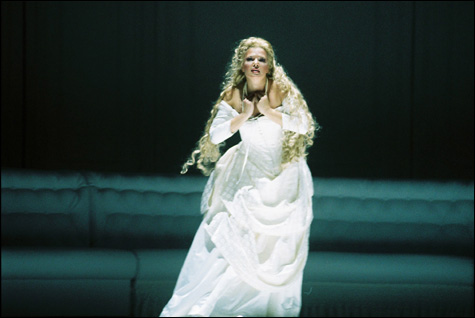
LA TRAVIATA: Marina Viskvorkina’s Violetta would satisfy the most demanding audience of any
great opera house. |
Teatro Lirico d’Europa was back for its second weekend this year, and in Verdi’s La traviata, Ukrainian soprano Marina Viskvorkina gave an extraordinary performance as the consumptive courtesan Violetta Valéry. Viskvorkina’s got just about everything: she’s a voluptuous blonde with a big, creamy voice of pinpoint accuracy, and she can act. She began by depicting a very flirtatious Violetta, though her famous first-act coloratura aria, “Sempre libera” (“Always free”), was a little pedestrian. Verdi’s Violetta at first rejects the true love offered by Alfredo Germont, her naive suitor, because she’s terrified of the risks of real feeling. Her “Sempre libera” was about a person who just wants a good time, not about the desperation of someone whose entire way of life is threatened. Her performance became increasingly inward and moving, conveying real dignity as Violetta confronts Alfredo’s father, who wants her to give up his son, and anguish at Alfredo’s public humiliation of her in the party scene. But it was in the last act, with the dying Violetta trying to rally when Alfredo returns, that Viskvorkina ascended to tragic stature. She’s one of the rare Violettas who sings the notes yet still convinces you that she’s physically failing and feverish. And she was heartbreaking. Her performance would satisfy the most demanding audience of any great opera house.As Alfredo, Mexican tenor Gabriel González revealed a likable personality, bare-bones acting skills, and an impressive voice that slid too often off the pitch. Alfredo’s father, Bulgarian baritone Plamen Dimitrov, didn’t have either the vocal heft or the dramatic imagination for this crucial role. He wasn’t embarrassing, but he mainly just stood there. One of my favorite Teatro Lirico singers, mezzo-soprano Viara Zhelezova, as Violetta’s friend Flora, was an object lesson in how to bring a character to life, even if it’s a small role. Character singers Hristo Sarafov and Vladimir Hristov were also exemplary. And an uncredited young male dancer was outstanding in the Gypsy number. The orchestra played better for Krassimir Topolov than it did in January’s Tosca, but he’s hardly anyone’s idea of an inspired conductor.
 Related
:
Topics:
Live Reviews
, teatro lirico d'europa
, Giuseppe Verdi
, Entertainment
, More  , teatro lirico d'europa
, Giuseppe Verdi
, Entertainment
, Music
, Classical Music
, Opera
, Less
, teatro lirico d'europa
, Giuseppe Verdi
, Entertainment
, Music
, Classical Music
, Opera
, Less 
