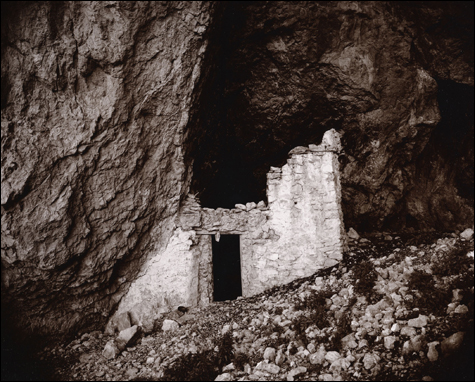
RETREAT, LAKE NAMTSO (1993). |
In the late 1970s, Linda Connor began photographing sacred sites. She recorded the misty mountaintop ruins of Machu Picchu; stick figures painted on canyon wall in Utah; the doorway of a tomb carved out a cliff at the ancient desert city of Petra in Jordan; the feet of a Nepalese sculpture of a goddess dancing on the back of a turtle; a small chorten, a Buddhist reliquary, standing at the bend of a meandering Indian river below a massive bluff; a monumental stone head of Apollo, seemingly keeping some ancient watch over the ruins atop Mount Nemrut in Turkey.
Her exhibit "Odyssey" at the RISD Museum (224 Benefit Street, Providence, through October 31) surveys some 70 photos that she made on her travels over the past three decades. "It is an attempt," she says in the catalogue, "to point toward the unfathomable and the unutterable."
Connor, who was born in 1944, studied with Harry Callahan at RISD (BFA 1967), then with Aaron Siskind, Callahan's pal at Chicago's Institute of Design (MS 1969). After learning from those two iconic photographic formalists, Connor, who has now lived in the San Francisco Bay Area for more than four decades, set off in a different direction: in search of a great soulful subject.
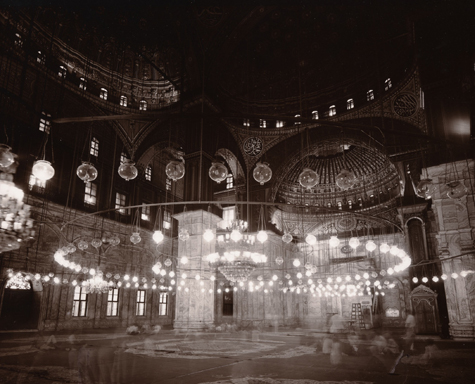
MUHAMMAD ALI MOSQUE, CAIRO, EGYPT (1989). |
She seeks out places and phenomena that dwarf us. Her 1989 photo In the Shadow of the Pyramid, Egypt, shows a person sitting on pocked sand, a speck in the shadow of the great stone monument. Here she records a manmade structure that exudes a sense of massive effort as well as the awesome gulf of time between its creation and now. A photo of an enormous baobab tree in Zimbabwe, casting its stout shadow in a wood of smaller trees, instills a similar sense of monumentality and time.
One of Connor's most striking photos is Moonbow, Victoria Falls, Zimbabwe, a night shot of Victoria Falls in 1996. The stars form curved lines in the sky because of the long photographic exposure. And a faint ghostly "moonbow" — a rainbow lit by moonlight instead of sunbeams — rises out of the waterfall's great cataract. It epitomizes Connor's search for the fleeting, the ineffable.
Pardon me for one moment while I roll my eyes at what at first glance appears to be Connor's hippie spiritual quest to the exotic East. Connor says she is recording other people's spirituality, not her own. "Faith in a religion or god is not part of the equation for me," she says in the catalogue. "Now I love the idea of angels. But do I think they're out there? No. Do I understand the desire of the human imagination to create them? Absolutely."
That said, you do find yourself transported back in time, slowing down, quieting, perhaps finding a meditative frame of mind to ponder ancient ancestors, the great sweep of time, the expanses of the universe. In the catalogue, photographer Robert Adams aptly calls it "a prayer book."
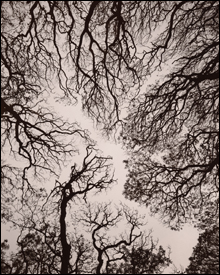
O'HIA, HAWAII (1997).
|
Connor purposely centers most of her subjects and favors symmetrical compositions to give her prints an iconic air. It's popular these days to print extra-large, but Connor makes 8x10-inch contact prints — straight from her large format negatives without enlargement — which increases richness of detail and tone, and draws you in close. She fixes her prints with gold chloride for a burnished, bronzed look. All of this combines with her subjects to give her photos an antique feel, a bit like Edward Curtis's otherworldly photographs of Native Americans from the early 20th century.
