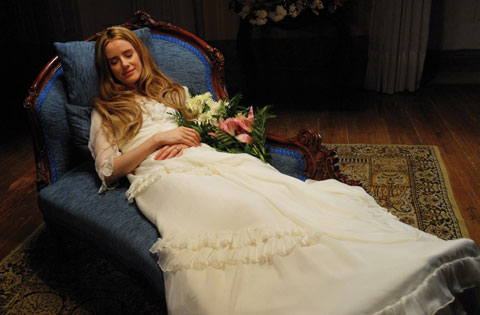
MÉLIÈS ERA Oliveira’s crude, archaic effects give his film an ironic magic. |
Now 102 years old and still turning out movies at the rate of one a year, Portuguese director Manoel de Oliveira seems destined to live forever. So perhaps it's appropriate that his newest film observes, with Olympian detachment, the tragi-comedy of mortals in pursuit of eternal love.
The mortal fool is Isaac (Ricardo Trêpa), a young Sephardic Jew with a ubiquitous camera and a mysterious past, a stranger in a backwater village on the banks of the Douro River, where the story is set. (It's also where Oliveira also set his first film, the 1931 documentary short "Douro, faina fluvial.") One rainy night, a minion from the wealthy Portas family calls on Isaac at his rooming house and insists he come to the estate and photograph the Portases' young daughter Angélica (Pilar López de Ayala), who's just died. They want to preserve her radiant beauty, her serene, almost lifelike smile. Indeed, when Isaac looks through the viewfinder of his camera, it seems that her eyes are opening and she's smiling at him.
The scene, in effect, reverses what happens in the key sequence of Michelangelo Antonioni's Blow-Up — instead of a picture of life revealing the presence of death, the camera's-eye view of a corpse reveals a living person. And though the medium of photography in Blow-Up only further blurs reality, here Isaac's camera drives him to an obsessive, unshakable perception of undeniable truth.
But of course his apparent dementia — his wide-eyed brooding over the poetry of 19th-century Portuguese philosopher Antero de Quental and his loud groaning at night — gets people talking. He ignores the other guests at the breakfast table, staring into space as they theorize about antimatter and the consummation of opposites. The fact that he's Jewish doesn't help — everyone regards him with unstated disdain. And suspicion: when the landlady's caged songbird dies, there are rumors of "witchcraft." Moreover, Isaac had already marked himself as an oddball with his hobby of taking pictures of the local workers tilling the vineyards with crude tools, as they've been doing for centuries. When the landlady asks him what's so special about these anachronistic practices, Isaac explains that he's "interested in the old ways of doing things."
So is Oliveira in his filmmaking. The narrative unreels with the simplicity of a silent movie; many scenes are shot from a single camera set-up with few cuts, the shadowy, stagy interiors backed by Chopin, as if it were a live piano accompaniment. And when the story enters the realm of the supernatural or the hallucinatory, Oliveira uses Méliès-era special effects that were already old hat around the time he was born.
The crude effects give an ironic magic to Angélica's ghostly appearances on Isaac's balcony — where, wearing a nightgown and a goofy grin, she rouses him from bed and embraces him with almost coital intensity and they sail off into the sky. The scene seems an inversion of the climax of Murnau's Nosferatu (1922), with the maiden taking the vampire's place and bestowing, if only in a dream, the blessing of eternity. Perhaps that's what Oliveira sees as the purpose of a lifetime making films: preserving what is loved and lost on the screen.
Angélica | WRITTEN AND DIRECTED BY MANOEL DE OLIVEIRA | WITH RICARDO TRÊPA, PILAR LÓPEZ DE AYALA, LEONOR SILVEIRA, LUÍS MIGUEL CINTRA, ANA MARIA MAGALHÃES, AND ISABEL RUTH | A CINEMA GUILD RELEASE | PORTUGUESE | 97 MINUTES | BRATTLE THEATRE: FEBRUARY 11-12 + 15-17
