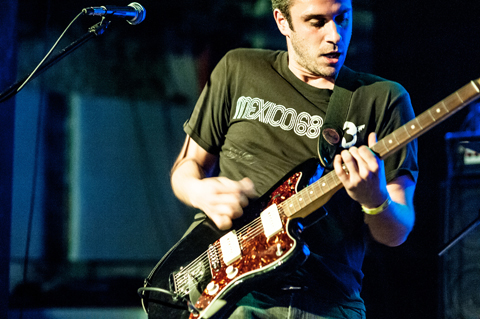
PUSHING BOUNDARIES Awaas. |
If metal is a fundamentally outsider genre, Awaas is what happens when a metal band looks in. The band's debut three-song, 17-minute EP is both a progressive musical statement and a stirring document of an important timeline in Maine, during which the unlikely election of a conservative governor (and in larger terms, the rise of Tea Party movement) mobilized a ton of creative youth to take action (and again, with the Occupy movement).
From their inception in the spring of 2011, Awaas eagerly cast themselves not only as different than a metal band, but more than a music group entirely. The group formed as a duo of Zack Howard and Eric Brackett (from the iconic Maine metal bands Conifer and Ocean, respectively) after a particularly icy winter, one in which two events would prove crucial to their identity. The first was Paul LePage's election as governor, and the second was that Corpse Pose, the promising and high-aesthetic rock band Howard and (briefly) Brackett had played with since that autumn, disbanded after only a few shows.
The pair fused the repetitiously arpeggiated riffs of DC post-hardcore group Lungfish, the churning rhythms of New York no-wave band Swans, and the clean and vibrant production values of modern post-rock. While metal was certainly a reference point, Awaas sounded and acted like an altogether different animal, transgressing the genre's trappings (such as escapism, obscurantism, and partyability) for a weirdly sincere community appeal. Once they added the third element of synth/electronics player Jacob Pitcher, their songs became more evenly balanced, which allowed the galvanized Howard, in his first stint as frontman, to entertain increasingly aesthetic and ministerial concerns. The band's live sets, where Howard would frequently inquire whether audiences could hear his lyrics, were endowed with banners bearing terse antislogans in minimalist sans-serif fonts. They challenged social formations (everyone is family/everything is political), systemic ideologies (cauterize capitalism), and retrogressive political figures (lepage must go), and were proof that Awaas were up to things no other band in town would dare.
The EP, which collects the three most distinctive songs of the band's early chapters, doesn't instruct a revolt so much as invoke the terms of one. "A Hazard Cry How," the uplifting and relatively brisk opener, conjures a battle in spare, impressionistic frames. "Cauterize" is a near-hymn, drenched in delay and a just a hair speedier than the glacial paces of Brackett's former band Ocean. It balances Howard's wailing plea ("stay with me, my brother") with the album's centerpiece lyric (the provocative and unexplicated "they use violence/maybe we should too"). In the song and the record as a whole, rage and confusion are applicable to many conditions of discontent — social, political, emotional; the music democratizes them all. On "Burial Ground," the record's third, final, and best track, a majestic, slow-burning guitar riff wrestles with seven minutes of ethereal synth chords. Howard's despairingly hopeful lyrics possess the concision and emotional candor of a Robert Creeley poem.
