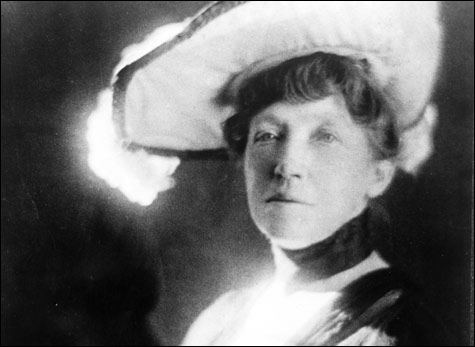
ISABELLA STEWART GARDNER: wanted things to stay in place, yet always stayed progressive. |
Isabella Stewart Gardner’s will is explicit: the experience she choreographed for visitors to her museum must continue in perpetuity. Not one of the 2500 objets d’art in its palatial rooms must ever be moved. The will is so ironclad that, nearly 18 years after thieves absconded with a Vermeer, three Rembrandts, and several other canvasses, their eviscerated frames are still on the wall.
But the most likely plan for the Gardner Museum’s proposed $60 million, 60,000-square-foot expansion (designed by architect Renzo Piano), might make for some drastic changes — including the demolition of the 1907 carriage house behind Fenway Court, Gardner’s Venetian-style palazzo.
Some community activists worry that the cramped, 105-year-old museum’s much-needed modernization will violate the wishes of Boston’s golden-age doyenne. “It’s clear that the museum needs more space,” says Ellen Moore, a member of Friends of Historic Mission Hill. But the carriage house, she says, is “not some dumpy garage. It’s really magnificent. It had an enormous amount of aesthetic and personal significance to [Gardner].” The will, Moore contends, “refers to plural ‘buildings’ . . . since there were no other buildings on the property at the time of the will, we believe [the carriage house] is protected.”
Museum officials insist that they spent a full decade rigorously deliberating the expansion before deciding that the new building — set 50 feet back from Fenway Court and relocating the museum entrance from the Fenway to a side street (Evans Way) — was the least invasive way to meet the museum’s needs while preserving Gardner’s mandate to provide for “the education and enjoyment of the public forever.” The current plan enjoys the support of the Boston Preservation Alliance, Boston Landmarks Commission, and Massachusetts Historic Commission.
In Gardner’s day, 1000 people visited the museum each year. Today, that number is 200,000. The new building, which will include a performance hall, a special-exhibition gallery, a gift shop, and a café, is vital to “serving visitors better, and improving our capacity to do good programming,” says the museum’s director of operations, James Labeck.
Labeck acknowledges the carriage house’s historic nature, and insists the decision to remove it was not made lightly, but claims Gardner’s will doesn’t contain “any relevant language” regarding it.
He does allow that the relocation of the museum’s entrance “means — and we’re still evaluating this — that we would create a new doorway through an existing wall [in the East Cloister] and we would have to move some portion of what is an installation near a sarcophagus.”
Moore also worries that addition will block light to the rear galleries.
“If you happen to be there in the afternoon when the light strikes them, it’s a very dramatic event,” she says, explaining that Gardner was extremely particular about the effects of natural light on her art.
Labeck concedes the point, but counters, “We moved the building as far away from the palace as we could, and we kept it as low as we can. . . . [T]aller buildings around us have had greater impact on daylight in our galleries.”
“Our mission is to retain the atmosphere of the collection as it was installed,” he says. But “the museum has some serious issues it has to deal with, with regard to the preservation of the palace and the collection.” Allowing that it’s a “really complex issue,” Labeck says the museum has “always been open to ideas. Any we receive will be considered.”
To that end, Moore encourages people to write or e-mail the Boston Redevelopment Authority during the project’s public-comments period, which ends January 10. Yes, she says, Isabella Stewart Gardner was a progressive woman. Ahead of her time. “She supported contemporary art, and would support a new building. But not this particular configuration that tears down her creation.”
To voice your opinion on the Gardner Museum’s proposed expansion, e-mail the Boston Redevelopment Authority’s Kristin Kara during the project’s public-comments period, which ends January 10.
