JULIUS CAESAR: This neurasthenic Shakespeare is slow going. |
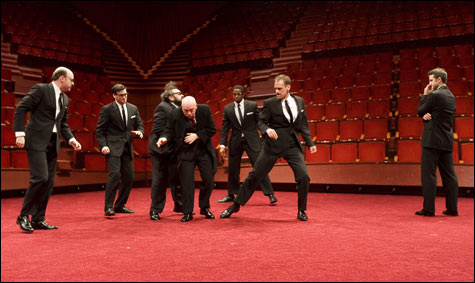
Those who went to high school in the 1960s may feel a wave of déjà vu at the American Repertory Theatre’s Julius Caesar (at the Loeb Drama Center through March 16). Not only is it riddled with references to the decade of the Kennedy and King assassinations, from skinny ties and pedestal furniture to a suspended vintage car and a nest of projected Loeb Drama Centers. It is also — as many found the play when forced to read it in ninth grade — slow going. French director Arthur Nauzyciel’s production is exasperatingly cool and deliberate, its characters political operatives sleepwalking through a public forum, here the Loeb and its several reflections, rarely making contact. The strange pacing, as well as surreal elements not emanating from the text, may be attributable to Nauzyciel’s other idea. He interprets the play not as a tragic collision of politics and portents but as the dream of a snoozing child: Brutus’s young servant, Lucius, here an amiable deaf-mute whose vision might better be titled When We Dead Awaken than Julius Caesar.Indeed, this Julius Caesar hovers between a smoky ’60s soiree and the afterlife, the living interacting with the dead as a jazz trio tootles hits for Billie Holiday and Peggy Lee. It’s as if the characters, listlessly re-enacting errors and manipulations of the past, were demonstrating how the more things change the more they stay the same, whether in the theater of politics or behind the scenes in the sunken living rooms of human affairs. And though it makes no sense, the pleasantly impassive Lucius, sometimes lying on the red-carpeted stage, at other times quietly watching, does seem subconsciously to be directing the action, for example coming to the front of the stage to presage the attack on Caesar in the Senate in a sort of dumb show.

Nauzyciel fields some striking visual ideas, particularly the projections of the theater that make Julius Caesar look like a production in the round, the players sometimes addressing the illusory empty seats, sometimes aiming their words at the real ones (which makes us the Roman citizenry otherwise absent from the production). And since there are two projected Loebs, the second flown but available to be lowered in front of the other, the director can change the size of the playing space to close in on Caesar’s assassination, or a brooding Brutus at home mulling that “It must be by his death” before opening his contemporary digs, behind whose diaphanous drapes a sleepless and sheet-draped Portia approaches, to the black-masked conspirators.
The slinky jazz combo — bassist Blake Newman, guitarist Eric Hofbauer, and vocalist Marianne Solivan in black lamé, her hair a ’60s pile of shellacked curls — add not only mood but also ironic counterpoint. An anxious Portia, sure something is amiss at the Senate, retreats to the side stage to sing back-up on “Say It Isn’t So.” And as Brutus, filled with misgivings following his confrontation with Cassius prior to Philippi, sits on a leather couch lost in thought, Solivan sashays centerstage to purr out “Suicide Is Painless,” the themesong from M*A*S*H. I especially enjoyed the Hamlet allusion in the lyrics.
But for all its dreamy, sometimes alluring ideas and pageantry, this neurasthenic Julius Caesar fails to engage. The characters speak more often to the æther or the auditorium than to each other. Sometimes this works, as when Brutus and Cassius, facing front, hands in pockets, test the waters of each other’s thoughts about solving the Caesar problem before it kills the Roman republic. But by the time Cassius has had a similarly furtive and distant exchange with Casca, you’re ready for some contact. And though Nauzyciel is respectful of the Bard’s words and the speeches are clearly spoken, the characters’ actions often run counter to the sense of what they’re saying. Things briefly come alive for the contest of oratory at Caesar’s funeral, though The Wire actor Jim True-Frost’s Brutus is more businesslike than eloquent in his embrace of Caesar save for his “ambition.” James Waterston’s wily Antony is more compelling, grabbing a convenient boom mike to amplify the word “mutiny” in his famed, rabble-rousing eulogy.
The actors appear to be following director’s orders, which are to present the play in a manner at once surreptitious and presentational. ART stalwart Thomas Derrah, an arrogant Caesar, is the most adept at marrying characterization with stylization. And Mark L. Montgomery makes a mercurial, nervous Cassius. But True-Frost never comes to life as the play’s focus, honorable assassin Brutus. Here the noblest Roman of them all just seems depressed.
