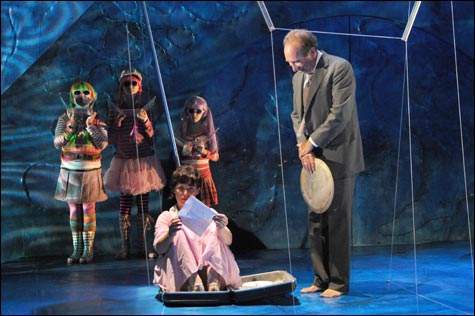
EURYDICE: What if Orpheus’s wife chose oblivion over the return to complicated life? |
A young woman steps off the Elevator Styx into a Hades ruled by Pee-wee Herman. The estimable Anna Deavere Smith embodies victims of war, cancer, and the Rwandan genocide as she turns herself into a Nancy Drew seeking to solve the mystery of “grace.” Mortality is on the menu this week in New Repertory Theatre’s Eurydice (at the Arsenal Center for the Arts through October 5) and the American Repertory Theatre’s Let Me Down Easy (at the Loeb Drama Center through October 11), works so diverse and piercing that they demonstrate the groaning board of theater, with shimmering myth at one end of the table, incisive documentary opposite.
Sarah Ruhl, now 34, began her profound and playful meditation on Orpheus’s wife while still a graduate student at Brown mourning a father who had died when she was 20. That her teacher was Paula Vogel will be apparent to anyone spellbound at the intersection of poetry and whimsy that is the locus of her work. In Eurydice, Ruhl shifts the focus from the ultimate music man, who induces the gods to release his dead wife and then loses her again when he fails to follow instructions, to Eurydice herself, as she’s caught between her desire to follow her husband back into the world and the delicate limbo in which she has reconnected with her deceased dad. Welcoming her to the Underworld, Eurydice’s father teaches her forgotten words and family history. And when the daughter who at first does not remember him (she thinks he’s a porter) demands to be shown to her room in this borderless territory occupied by a bossy chorus of talking stones and ruled by a petulant prince on a tricycle, he lovingly constructs her a shelter of string.

Ruhl’s unconventional Eurydice explores both the pain of loss and the converse comforts of memory and forgetting, music and language. Orpheus’s thoughts are tunes; Eurydice loves books. In Hades, where the river Lethe is a slit in the floor, the Stones advocate letting go of earthly recollection. And in Ruhl’s Freudian version of the tale, it is not Orpheus who makes the mistake that sends his recovered wife back to the Underworld but Eurydice herself, choosing childish oblivion over a return to complicated life.
Ruhl’s work must be difficult to pull off, teetering as it does between mystery and quirkiness. Much of its affect is in its imaginative imagery and strange non sequitur. Hell is reached by an elevator in which it’s always raining. Eurydice, unable to summon Orpheus’s name, recalls that “it starts with my mouth like a ball of twine.” Director Rick Lombardo adds to the Alice in the Underworld scenario a percolating, otherworldly sonic landscape, and Janie E. Howland’s set makes Hades look like the inside of an atom: a blue cave in which curved metal rods delineate the orbits of electron-like spheres that constantly change color.
It’s obvious that Lombardo, who last season directed The Clean House, is attuned to Ruhl’s magical-realist spirit. He even adds flourishes of his own, among them casting the chorus of stones as a trio of ’tween girls dressed like something off the shelves of Toys “R” Us. Among the adult actors, Zillah Glory is a giddily emotional Eurydice, and Ken Baltin imbues her father with an insouciant, understated tenderness. Brian Bielawski’s Orpheus, ricocheting between anguish and cool, registers less vividly. But that may be because the music of Eurydice is in its yearning-filled swirl of words and pictures.
Anna Deavere Smith also trails her toes in the Styx, but she’s a long way from the shores of caprice. Let Me Down Easy, like the Obie-winning writer/performer/professor’s previous one-woman, multi-character forays into documentary theater, is based on hundreds of interviews she conducts and then commits to body memory so she can portray their subjects from the outside in and from the inside out. But this work, described as “a play in evolution,” is more diffuse than its forerunners.
Fires in the Mirror dealt with the Crown Heights riots; Twilight: Los Angeles, 1992 explored the violence set off by the Rodney King beating. Let Me Down Easy began as an exploration of the resilience and vulnerability of the human body. But the human spirit proved impossible to ignore, and Smith starting sleuthing for the ineffable something — she calls it grace — that gets us through acute distress, whether it’s due to war, disease, or evil acts of God or Man. She traveled to the Yale and Stanford medical schools, Houston’s M.D. Anderson Cancer Center, Rwanda after the genocide, and New Orleans after Katrina. She talked to religious leaders, health-care professionals, patients undergoing treatment, victims and perpetrators of genocide, even the jockey who rode Eight Belles to her collapse following the Kentucky Derby. And she sets these people before us, transforming herself with bits of costume, changes of stance, and the uncanny reproduction of the voices, cadences, and x-rayed personae of her subjects. The piece lacks the both-sides-now approach to a specific divisive event that characterized Fires and Twilight. But all of it is intelligent and parts are indelible.
