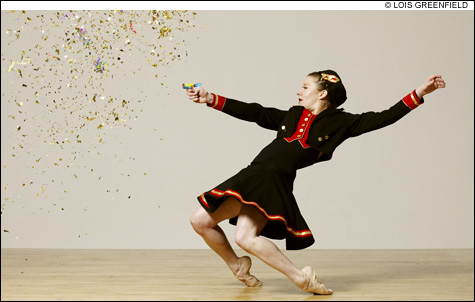
PATRIOT ACT UP: Mary Cochran was the perky drum majorette who’s transitioned from football field
to ballet stage. |
Sara Hook explains the title of her cabaret piece Salad Days as a reference to youth and indiscretion. At Harvard Dance Center on Saturday night, quite a lot of the evening looked more like grown-up and decadent. Hook’s New York–based group featured former Paul Taylor dancer Mary Cochran and three other women, with David Parker as a guest artist, in five brief portraits choreographed over the past 10 years.
What really held the parts of the evening together for me was Hook’s take on female performers. As distinct characters or anonymous dancer-dancers, they all appeared flawed, flummoxed, but determined to scramble over any choreographic hurdle.
Cochran opened the performance with Patriot Act UP (2004), as the perky drum majorette who’s transitioned from football field to ballet stage in things like George Balanchine’s Stars and Stripes. To a rousing drumbeat and a Sousa march, Cochran ripped through a precision routine, one mechanical move to the beat, an encyclopedia of struts and prances, head tilts, simpering smiles, lifted shoulders and phony salutes. Driven to keep up with the music, she worked feverishly to please, pulling one foolish prop after another out of her jacket as she grew more strained and artificial.
Rue (1998) did have a quality of naïveté, and it most closely suited the ingénue roles Cochran played so memorably in the Taylor repertory. To Schubert’s “Du bist die Ruh” (sung on tape by a sweet soprano), Cochran wafted with a sort of deranged romanticism. Wearing a dilapidated long tutu and a pink Dynel wig, she conveyed the raptures of a lovelorn but slightly unsteady ballerina. In the midst of some breathy advance, she’d fall flat, recover awkwardly, go on again until the next stumble. At the end of the song she staggered out backwards, still pleading with both hands to her invisible lover.
Three vignettes made up The Valeska Trilogy, a homage, or perhaps a satire, invoking the transgressive Weimar cabaret performer Valeska Gert. Cochran first played an adorable but unsteady music-hall entertainer, with banal ballet enchaînements. Then came cheap exhibitionism, as she lashed from kitschy Charlestons to auto-erotic writhings. Finally she subsided into a desperate proto-modern dance.
David Parker partnered her but never served as a conventional cavalier. He manipulated swags of orange cloth on batons to simulate stage curtains, flags, and Loie Fuller serpentines, upstaging and ensnaring Cochran with them as often as he showed her off. He filled in during her costume changes as a conceited weightlifter and a psychiatrist teasing out the sexual secrets of an audience member Cochran-Gert had tried to seduce. Parker is a wonderful mime, capturing a character’s posture, face, and voice but keeping his intensity just below the boiling point. Cochran did go over the top as Gert, with a ferocious raunchiness and a touching meltdown.
Erika Randall in Game Point (2005) and Paige Cunningham and Angela Fleddermann Miller in the new duet Salad Days were younger and stronger but also struggling to stay afloat. Randall powered through a series of modern-dance moves that ended with wrenching reverses and flung-away endings, to a tape of Anne Sexton reading her poems about old age and madness.
The duo developed variations on a walking dance. Their issue seemed to be staying in unison, and Fleddermann Miller counted under her breath to keep track of the steps. Each woman stole moments to drop out or push herself forward. Just as the dance seemed to be winding down, they’d begin a new episode. Miller gestured and twisted for ages while standing on one leg, leaning against Cunningham’s hand. Cunningham sat in a chair but kept sliding down out of it. They joined in a ballet line, a kick chorus. Chugging and heaving, they rested a minute as Miller took off her shirt and waited for the audience to react. The climax passed. They soldiered on together.
